admin
admin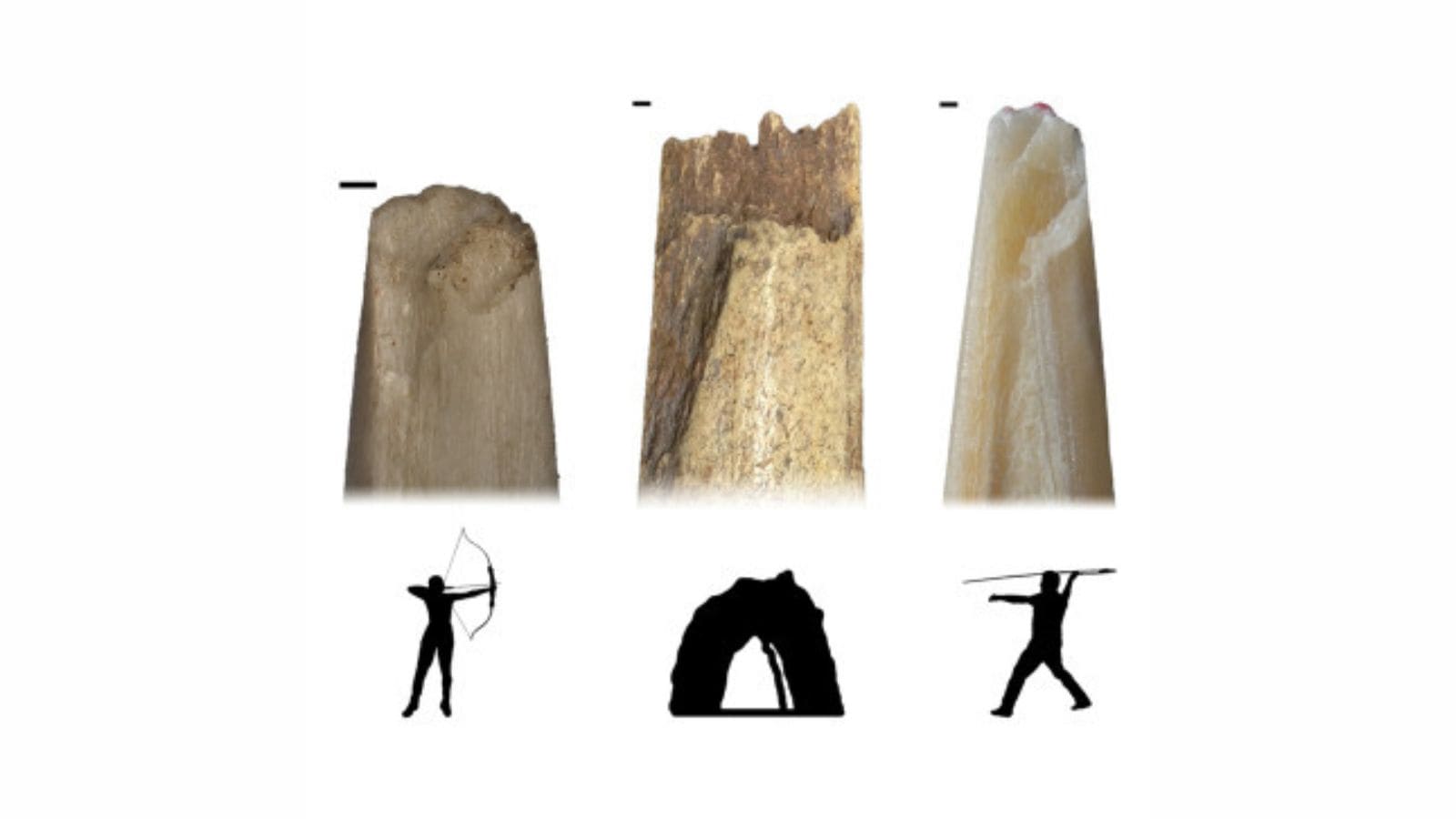
For much of the last century, archaeological perspectives on ancient weapons adhered to a clear, sequential narrative. Early humans were thought to start with basic handheld spears, then use spear-throwers to enhance their range of attack, and later became skilled with the bow and arrow. However, recent studies indicate that the truth was significantly more intricate and considerably more fascinating.
Research conducted by Keiko Kitagawa from the University of Tübingen disputes the traditional belief that hunting technologies developed in a straightforward, linear manner. The study says that early Homo sapiens in Europe might have tested various weapon systems, such as bow-and-arrow technology, much earlier than previously believed.
The results are outlined in a recent paper published on December 18 in iScience, which re-evaluates how ancient projectile points were utilised.
Rethinking the archaeological record
One major obstacle to understanding prehistoric hunting is the scarcity of direct evidence for weapons. Most hunting tools were made from wood, sinew, and other organic materials that do not preserve well over tens of thousands of years. What usually survives are stone, bone, or antler tips, fragments of a much larger technological system.
As the researchers point out, prehistoric hunting weapons ranged widely in form and function. Close-range tools included handheld thrusting spears, while medium- and long-range options involved spears launched with spear-throwers or arrows shot from bows. The earliest known wooden spears and throwing sticks in Europe date back roughly 337,000 to 300,000 years ago. Much later, antler objects interpreted as spear-thrower hooks appear in Upper Solutrean contexts between about 24,500 and 21,000 years ago, becoming especially common during the Magdalenian period in southwestern France after 21,000 years ago.
In contrast, bow-and-arrow technology has traditionally been considered a very late arrival in Europe. Clear examples have been identified at only a handful of exceptionally preserved sites, such as Mannheim-Vogelstang and Stellmoor in Germany, dating to around 12,000 years ago, and the Early Mesolithic site of Lilla Loshults Mosse in Sweden, dating to roughly 8,500 years ago. On the surface, this suggests bows and arrows were a relatively recent innovation.
The study conducted by Kitagawa and her team investigates ancient projectile tips, focusing on their degradation rather than whole weapons. Emphasising bony tools like antler and bone points from Aurignacian contexts (40,000-33,000 years ago), the research employs experimental setups to launch replica points and analyse fracture patterns against archaeological finds. Findings indicate specific patterns suggesting bow and arrow use, challenging previous timelines.
Story continues below this ad
The research highlights the complexity of reconstructing ancient projectile technology, hindered by material decay and varied influences on point damage, including raw material properties and impact angles. This methodology sheds light on upper Palaeolithic hunting practices by examining damage patterns instead of focusing solely on intact artefacts.
© IE Online Media Services Pvt Ltd