admin
admin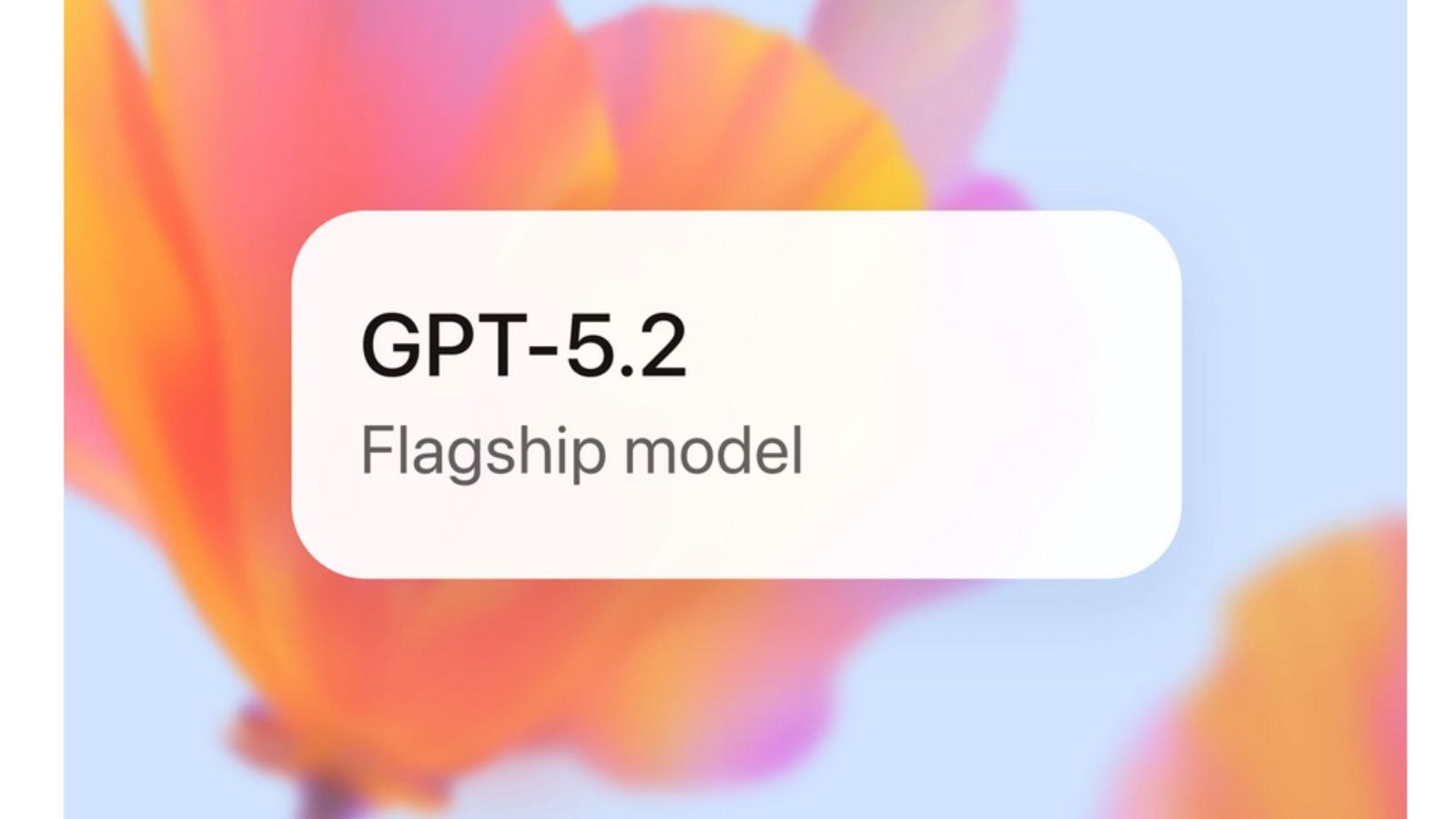
Days after internally declaring a ‘code red’ over Google’s edge in AI, OpenAI appears to have fired back with a new advanced model. The Sam Altman-led AI powerhouse has introduced GPT-5.2, which it describes as its most advanced frontier model for professional work and long-running agents.
OpenAI says the new model is its most capable series yet for professional knowledge work, designed specifically for enterprise use.
What is GPT-5.2?
GPT-5.2 is essentially a new generation of AI models that are faster, more capable, and far better at real workplace tasks when compared to their predecessors. In simple words, if you have been using AI to summarise long documents, check code, draft a presentation, collate data in spreadsheets, etc., then this model pushes all these abilities much closer to what a human expert will be able to do.
According to OpenAI, the companies that have been using ChatGPT Enterprise claim to have saved 40-60 minutes a day. The company claims that heavy users have reduced 10 hours a week from their workload. Now, with GPT-5.2, these gains are going to accelerate even more.
OpenAI claims that GPT-5.2 is better at producing spreadsheets and presentations, writing and debugging code, understanding and analysing images, reading extremely long documents, solving multi-step tasks without getting lost midway through, and even calling external tools such as search, databases or company software. In simple words, GPT-5.2 has been developed for people who use AI as part of their daily work and not just for quick queries.
In regular ChatGPT, GPT-5.2 comes in three versions – Instant, Thinking and Pro. Instant is for faster responses for everyday tasks, while Thinking is meant for more structured and detailed reasoning for complex work, and Pro yields the highest quality answers for complex and technical problems.
GPT-5.2 is rolling out across paid ChatGPT plans initially. In the API, it’s available immediately as gpt-5.2, gpt-5.2-chat-latest and gpt-5.2-pro. Token pricing is higher than GPT-5.1 but still below competing frontier models, and due to greater efficiency, producing high-quality results often costs less overall.
Story continues below this ad
GPT-5.2 performance
In its official blog, OpenAI revealed that GPT-5.2 underwent one of the biggest tests, known as GDPval. This test is a significant evaluation that checks how well an AI model performs tasks across 44 real-world professions ranging from finance to sales operations to design. On the other hand, the most capable version of the model, GPT-5.2 ‘Thinking’, reportedly matched or outperformed industry professionals on 70.9 per cent of tasks, which is almost double the score of GPT-5.
When it comes to coding, on SWE-Bench Pro, a benchmark that simulates real-world engineering tasks across four programming languages, GPT-5.2 set a new record. The model is reportedly better at debugging, implementing features, reviewing code, and handling entire end-to-end engineering tasks. The developers who tested the new model also found that the model performed better on front-end jobs, including generating 3D interfaces or complex visuals from natural language prompts. All of these tasks were accomplished with fewer mistakes.
Text processing and multi-step project handling
OpenAI also claims that the new model comes with fewer hallucinations. GPT-5.2’s most impressive aspect is that it can process huge amounts of text. The company said that the model can keep track of information across hundreds of thousands of tokens. In OpenAI’s long-context benchmarks, the model hit near-perfect accuracy even when relevant details were buried deep across massive files.
Another important area is tool use. The model is reportedly better at handling multi-step tasks that involve external tools. On Tau2 benchmarks, GPT-5.2 secured 98.7 per cent accuracy in telecom-based customer support scenarios. This means that when an answer requires multiple steps, multiple tools and some planning, the model is far less likely to get lost. The company also claims that in tests it handled complicated customer-service situations such as rebooking travel, locating luggage, arranging hotels and even applying medical-seating requests. All of this was completed in one continuous workflow, something older models would have dropped halfway.
Story continues below this ad
This means, for people who work with contracts, research papers, legal documents, transcripts or multi-file projects, the model can be ideal. It makes it possible to ask questions about gigantic datasets without manually breaking them up. The model also comes with better vision capabilities. GPT-5.2 is much stronger at interpreting charts, dashboards, technical diagrams, UI screenshots and even low-quality images. Its accuracy in scientific figure reasoning and software interface understanding has improved significantly.
Beyond workplace use cases, GPT-5.2 has also demonstrated steep improvements in advanced scientific and mathematical reasoning. On graduate-level science questions, it reached over 92 per cent accuracy, while on expert math problems, it set a new record. According to OpenAI, researchers have already used it to propose proofs in statistical learning theory that were later validated by human experts.
What does it mean for OpenAI?
The AI startup has been facing intense competition from Google ever since the latter announced Gemini 3, which performed strongly across a variety of benchmarks. Following Gemini 3’s success, Sam Altman declared a ‘code red’ earlier this month. Competition has also intensified from another peer, Anthropic, which launched its advanced model Claude Opus 4. In his note to staff, Altman urged them to focus on improving the quality of the chatbot while delaying other plans, including the integration of ads.
With the new model, OpenAI is anticipating more economic value for users, as it is better at creating spreadsheets, building presentations, and managing complex multi-step projects.