admin
admin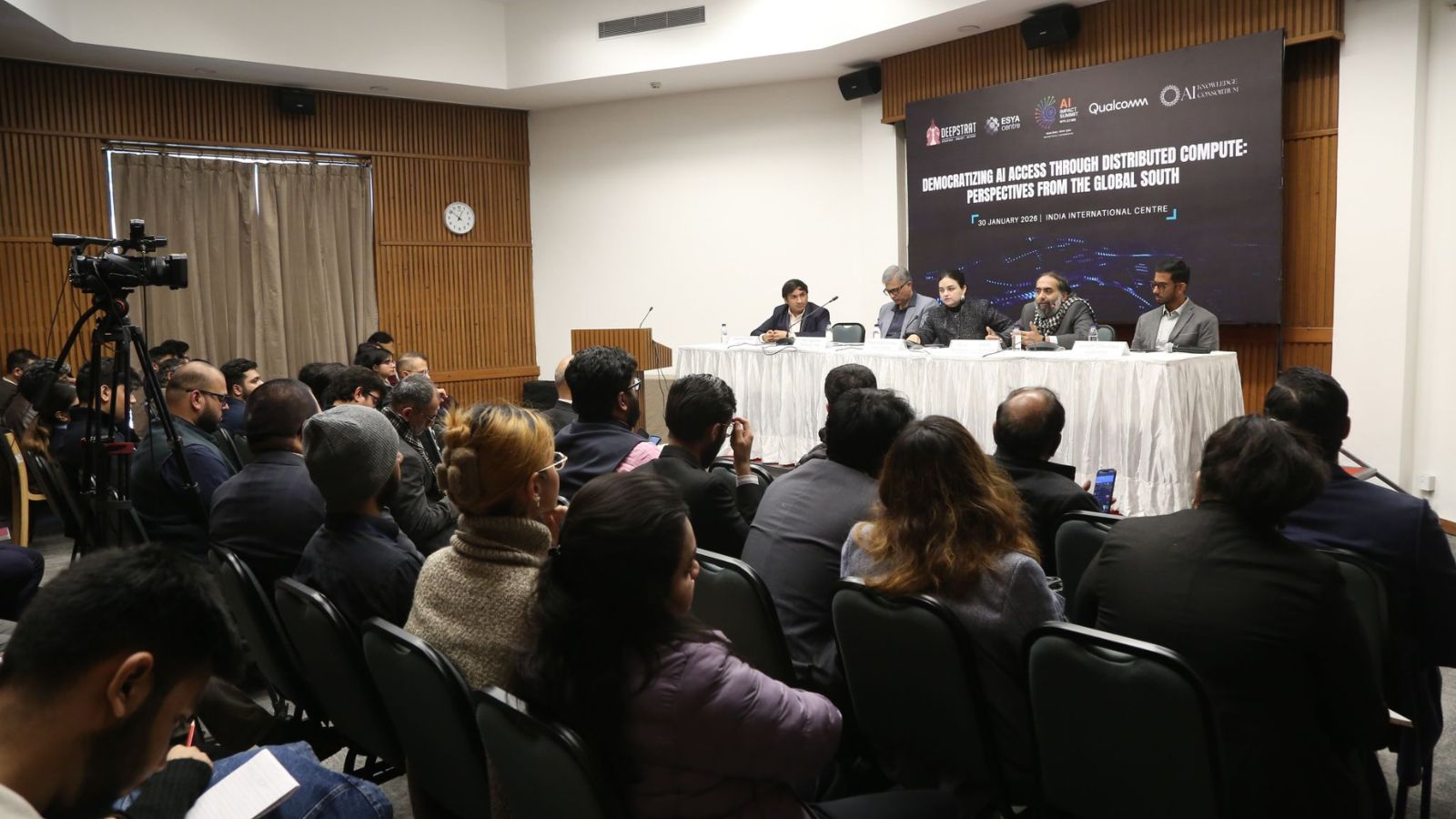
Amid the global race to build large, energy hungry AI models, India seems to be leaning toward a more pragmatic ‘bottom-up’ approach to AI development, with edge AI emerging as a key focus area.
“Having more edge AI data centres is something that we would like to look at much more seriously as an alternate approach,” said S Krishnan, Secretary, Ministry of Electronics and Information Technology (MeitY). Highlighting the importance of where data is held, Krishnan said that smaller edge AI data centres are pivotal for use cases such as AI models deployed in vehicles, as safety critical systems cannot afford latency. “Computing at the edge eliminates latency and makes sure it is more efficient,” he added.
The IT Ministry secretary was speaking at a pre-Summit event titled ‘Democratising AI Access Through Distributed Compute’ organised by the AI Knowledge Consortium in collaboration with Delhi-based think tanks, Esya Centre and Deep Strat on January 30.
The event was one among hundreds of similar pre-Summit meets that have been held across the country in the run-up to the global AI Impact Summit 2026 hosted by India in New Delhi between February 16 and February 20. The exhibition to be held alongside the Summit has already drawn applications from over 450 start-ups, with more than 70,000 attendees registered, as per Krishnan.
Krishnan further said that India should focus on developing small language models (SLMs) that can cater to specific sectors such as healthcare. “Why are we obsessed with generative AI? Why are we not looking at other aspects of AI and other ways in which AI can be used? Previous generations of AI can be used, fine-tuned, to actually generate better results,” he said.
“Rather than set up huge compute facilities directly by the government or give large viability gap funds to companies to establish compute facilities, we decided to subsidise access to compute under the India AI mission,” he added.
The senior government official’s remarks were in line with the findings of the Economic Survey 2026-27which batted for a ‘bottom-up’ approach to AI development, and a decentralised path that allows AI capabilities to spread widely across sectors while avoiding the high capital expenditure, energy intensity, and hardware dependencies that characterise Western frontier model development.
Story continues below this ad
But why is edge AI particularly important for India? What are the policy blind spots around hybrid AI? What infrastructure is needed for smaller labs and start-ups to meaningfully participate in India’s hybrid AI ecosystem?
These were a few of the questions tackled by a panel of experts comprising Abhishek Kankani, Head of Emerging Tech and Incubation, Cloudflare India; Rajiv Aggarwal, Senior Vice President, Samsung India; Sidharth Choudhary, Senior Manager, Qualcomm; and Sundeep Narwani, Co-Founder, Narrative Research Lab, with the discussion being moderated by Meghna Bal, Director, Esya Centre.
Major themes of the panel discussion
AI in your pocket
Batting for local AI models that can be run on mobile phones with 12GB RAM, Narwani said, “We need to start building more local AI models because they offer three key advantages. First, unlike large centralised models that incur ongoing transaction and token costs with every use, a locally deployed model eliminates these recurring costs. Second, once installed, the deployment is a one-time process and does not need to be repeated. Finally, because the model runs locally, you can keep building more advanced layers on top of it.”
“I do want to add a disclaimer that phones can heat up, so you may need an additional fan, and it can look a bit unusual when you are loading large AI models. That said, it is very much possible for anyone to go home and try this out. In terms of distribution of compute, it is split between what happens in the cloud and what inference can happen on the phone itself. If you are working with images and want your phone to interpret them and take action, it is possible to handle nearly 80 per cent of that processing on-device,” Narwani said.
Story continues below this ad
In response to a question about whether smartphones should be considered part of the national AI infrastructureSamsung’s Rajiv Aggarwal said that mobile phones are the primary medium for reaching consumers and ensuring they are able to benefit from new technologies. “For us, I would say almost 7 out of 10 appliances that would be provided to consumers would be AI-enabled. So you can very well imagine the expanse of AI as a technology, as a layer, not only in terms of features and what we can do as a technology provider but also providing services to consumers directly.” “Infrastructure also refers to the connective layer that brings everything together, with smartphones playing a central role,” Aggarwal added.
Privacy benefits of locally run AI models
“There is a concept known as quantisation, where a larger model is compressed so it can run on local or edge systems. If this can be done effectively, the same language model can be deployed for multiple purposes. This creates room for entrepreneurs to experiment and enables a wide range of local use cases, such as an enterprise environment or a hospital running the model for its own needs,” Narwani said.
“Entrepreneurs can then build models tailored to specific purposes. The same underlying model could be used by journalists for transcription, especially when they do not want to upload interviews online for translation or transcription due to privacy concerns. In such cases, running the model locally, for example on a phone, becomes a viable alternative, although the models would still need to be trained according to specific requirements,” he added.
Data sovereignty as a barrier to edge AI
Stating that the government is trying to solve for data sovereignty, Cloudflare’s Abhishek Kankani said, “Localising everything seems good on paper but it will lead to re-investing in heavy compute again and again without fully leveraging existing resources.”
Story continues below this ad
“This is something I have also been personally working on, namely how to enable the right level of control. That control makes policies programmable, allows security layers to be added, and eases the risks that arise today when data is processed in centres outside one’s localisation boundaries,” Kankani said.
Identifying connectivity and capex as the policy blind spots around hybrid AI, Kankani said, “Most data centres in India are in either Bengaluru or Mumbai. So apart from those cities, when you go to the outskirts, you actually don’t have access to good compute very easily.”
“With edge AI, that becomes really quick where you have someone sitting in a tier-3 city and a centre very close to them. So they don’t have to sort of rely on the fact that we need great connectivity and continuous internet. It’s not about the speed, but it’s about the quality of the connection, right? So I think making this accessible where you get rid of the heavy compute requirement, and you get rid of the heavy capital requirement, is a key part,” he added.
Regulatory interventions needed for edge AI adoption
When asked about the barriers to large-scale adoption of edge AI in India, Aggarwal said that it was more of a question of time. “See, manufacturers will always come in with technologies and products that the society is playing with. At the same time, there is a demand-driven pull that also shapes adoption. AI has already emerged as a major technology, not just in India but globally. While it remains an open question whether this is a bubble, there is little doubt that AI is here to stay, not only as a high-end computing technology but as one that directly impacts citizens,” he said.
Story continues below this ad
“What we need to look at, technically, is keeping edge AI as one of the pillars of the AI mission. There is significant value to be created, especially since the primary device has been the mobile phone. When we consider power consumption, latency, and related factors, edge AI comes very naturally to us, rather than a cloud-first approach, because of the one-device aspect,” Qualcomm’s Sidharth Choudhary said.
“What we have been trying to do is educate policymakers across the government on why this is important. Our focus has been to demonstrate real use cases and show that stakeholders on the ground need concrete problems to be solved by AI, and that how effectively those problems are addressed is what truly matters,” he further said.
“The thing that underpins all technology is interoperability. The safest way to leverage latent compute is to ensure interoperability between all these different tech stacks that are coming up, that is where there is also a need for mandating open standards and protocols,” Kankani said.