admin
admin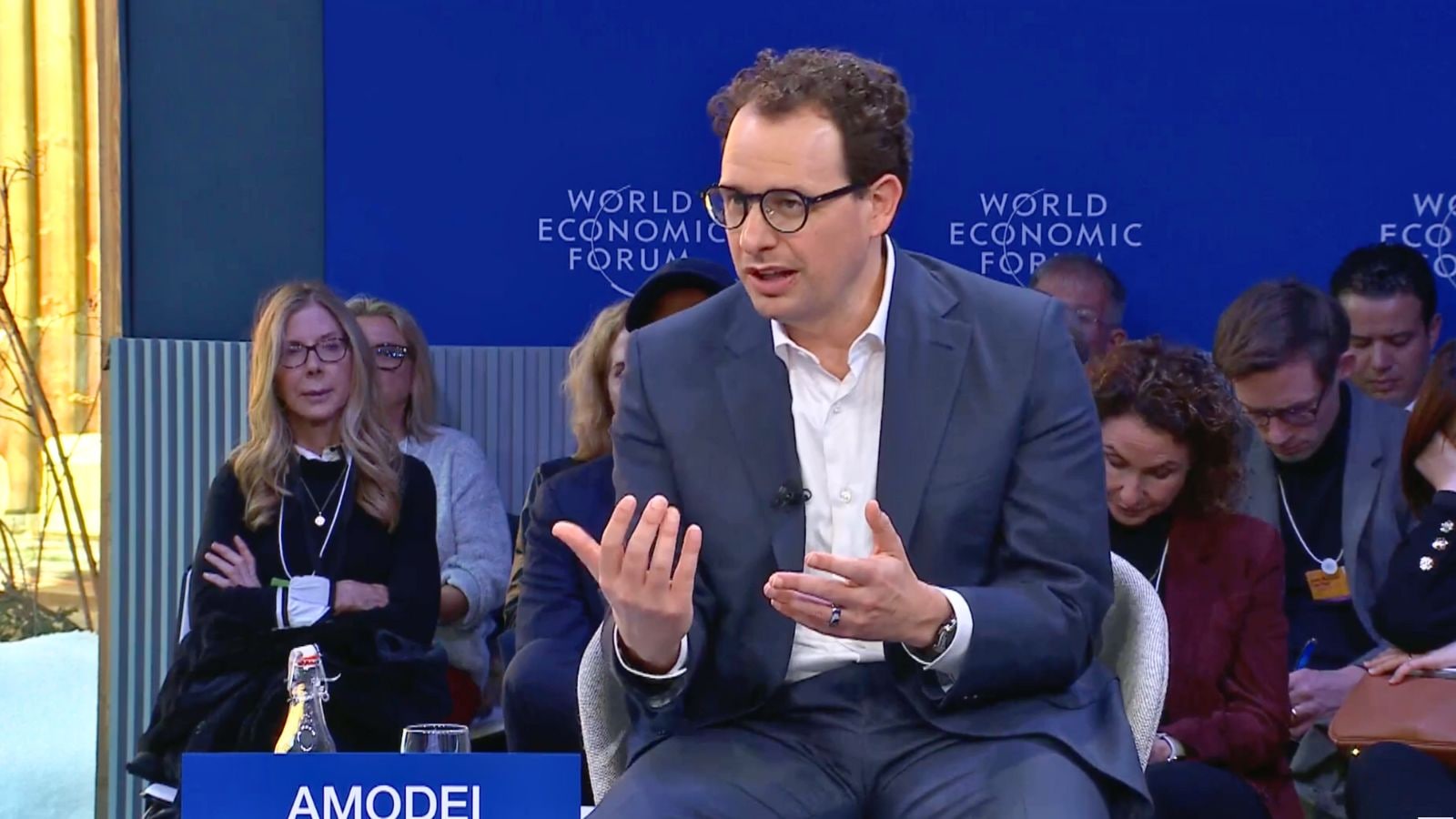
What would keep you up at night if artificial intelligence (AI) systems became as capable as humans? We know Dario Amodei’s answer.
In a lengthy 20,000-word essay titled ‘The Adolescence of Technology’the Anthropic CEO laid out what he regards as the potential harms of AI, including autonomous AI systems with unpredictable behaviour, bad actors or terrorist groups using AI tools to create bio-weapons, and some countries exploiting AI to establish a “global totalitarian dictatorship”.
Amodei has also issued a fresh warning about the impact of AI on the job market, saying that it will cause “unusually painful” disruption bigger than any before. “Humanity is about to be handed almost unimaginable power, and it is deeply unclear whether our social, political, and technological systems possess the maturity to wield it,” he said in the blog post published on Monday, January 26.
In broad strokes, the essay moves away from the techno-optimist views outlined in Amodei’s 2024 long-form post titled ‘Machines of Loving Grace’, where he envisioned a future in which AI risks had been mitigated, and powerful AI was applied with skill and compassion to improve the quality of life for everyone.
By powerful AI, Amodei means AI systems that are “smarter than a Nobel Prize winner” in fields like biology, programming, math, engineering, writing, etc, and can perform tasks such as proving unsolved mathematical theorems, writing extremely good novels, generating entire codebases from scratch, and more.
In his latest essay, Amodei looks to map out the catastrophic risks posed by AI while also formulating a “battle plan” to address them.
Why it matters
Amodei co-founded Anthropic in 2021 with his sister, Daniela Amodei, and is behind the creation of the Claude series of large language models (LLMs). In recent years, Dario Amodei has become known for his penchant for lengthy essays, sometimes shared internally via the company’s Slack channel, as his signature style of communication.
Story continues below this ad
While the essays published on his personal blog could be seen as novella-length marketing pitches, they also appear to be more than the average tech CEO pontificating about AI. Amodei is easily one of the most influential figures in the AI industry, and for those buying into the Silicon Valley vision, his writings offer a measured and unusually engaging window into where AI may be headed.
Headlines about Amodei’s essay have inevitably focused on his warnings about AI destroying humanity. However, he has said that it is critical to avoid AI doomerism by discussing and addressing potential risks in a realistic, pragmatic manner. His essay also comes with a disclaimer: “There are plenty of ways in which the concerns I’m raising in this piece could be moot. Nothing here is intended to communicate certainty or even likelihood (…) No one can predict the future with complete confidence—but we have to do the best we can to plan anyway,” he wrote.
Here are the key takeaways from Amodei’s comprehensive essay, which draws on references ranging from sci-fi classics such as Contact and 2001: A Space Odyssey to dystopian literature such as Orwell’s 1984and even mentions the Unabomber.
Timeline for powerful AI
Exactly when powerful AI will arrive is a complex topic that deserves an essay of its own, but for now I’ll simply explain very briefly why I think there’s a strong chance it could be very soon.
Story continues below this ad
Powerful AI is the level of intelligence that raises civilisational concerns for Amodei. He defines it as any AI system that is smarter than a Nobel Prize winner across fields, has access to all the interfaces available to a human working virtually, and can autonomously complete tasks that would otherwise take a human hours, days, or weeks to complete. Likening it to a “country of geniuses in a data centre,” Amodei posits that these systems will not have a physical embodiment other than a computer screen, but can control existing physical tools, robots, or laboratory equipment through the computer screen.
Amodei said he believes that such AI systems could arrive “very soon” because “there has been a smooth, unyielding increase in AI’s cognitive capabilities.”
“Three years ago, AI struggled with elementary school arithmetic problems and was barely capable of writing a single line of code (…) If the exponential continues—which is not certain, but now has a decade-long track record supporting it—then it cannot possibly be more than a few years before AI is better than humans at essentially everything,” he wrote.
Autonomy risks
Amodei has sought to sketch out the risks of AI through a common metaphor: “Suppose a literal “country of geniuses” were to materialize somewhere in the world in ~2027. Imagine, say, 50 million people, all of whom are much more capable than any Nobel Prize winner, statesman, or technologist.”
Story continues below this ad
Acknowledging that the analogy is not perfect, he continues, ”…suppose you were the national security advisor of a major state, responsible for assessing and responding to the situation. Imagine, further, that because AI systems can operate hundreds of times faster than humans, this “country” is operating with a time advantage relative to all other countries: for every cognitive action we can take, this country can take ten. What should you be worried about?”
The first category of risks identified by Amodei has to do with autonomous AI systems.
“There is now ample evidence, collected over the last few years, that AI systems are unpredictable and difficult to control— we’ve seen behaviors as varied as obsessions, sycophancy, laziness, deception, blackmail, scheming, “cheating” by hacking software environments, and much more,” Amodei wrote.
“AI companies certainly want to train AI systems to follow human instructions (perhaps with the exception of dangerous or illegal tasks), but the process of doing so is more an art than a science, more akin to “growing” something than “building” it. We now know that it’s a process where many things can go wrong,” he said.
Story continues below this ad
“I make all these points to emphasize that I disagree with the notion of AI misalignment (and thus existential risk from AI) being inevitable, or even probable, from first principles. But I agree that a lot of very weird and unpredictable things can go wrong, and therefore AI misalignment is a real risk with a measurable probability of happening, and is not trivial to address,” he added.
Bio-terrorism risks
“Biology is by far the area I’m most worried about, because of its very large potential for destruction and the difficulty of defending against it, so I’ll focus on biology in particular. But much of what I say here applies to other risks, like cyberattacks, chemical weapons, or nuclear technology,” he wrote.
“At a high level, I am concerned that LLMs are approaching (or may already have reached) the knowledge needed to create and release them end-to-end, and that their potential for destruction is very high. Some biological agents could cause millions of deaths if a determined effort was made to release them for maximum spread,” he said.
“However, this would still take a very high level of skill, including a number of very specific steps and procedures that are not widely known. My concern is not merely fixed or static knowledge. I am concerned that LLMs will be able to take someone of average knowledge and ability and walk them through a complex process that might otherwise go wrong or require debugging in an interactive way, similar to how tech support might help a non-technical person debug and fix complicated computer-related problems (although this would be a more extended process, probably lasting over weeks or months),” he wrote.
Story continues below this ad
China and AI-enabled autocracies
Amodei has warned that countries such as China could use their advantage in AI to gain power over other countries. “If the “country of geniuses” as a whole was simply owned and controlled by a single (human) country’s military apparatus, and other countries did not have equivalent capabilities, it is hard to see how they could defend themselves: they would be outsmarted at every turn, similar to a war between humans and mice. Putting these two concerns together leads to the alarming possibility of a global totalitarian dictatorship. Obviously, it should be one of our highest priorities to prevent this outcome,” he wrote.
The ways in which AI could enable, entrench, or expand autocracy include fully autonomous weapons such as swarms of drones, AI surveillance tools, AI propaganda tools, etc.
“Broadly, I am supportive of arming democracies with the tools needed to defeat autocracies in the age of AI—I simply don’t think there is any other way. But we cannot ignore the potential for abuse of these technologies by democratic governments themselves,” Amodei wrote, without naming any countries.
Shock to labour market
In his essay, Amodei elaborated on his argument that humans will find it difficult to recover from the short-term impact of AI on the labor market. “New technologies often bring labor market shocks, and in the past, humans have always recovered from them, but I am concerned that this is because these previous shocks affected only a small fraction of the full possible range of human abilities, leaving room for humans to expand to new tasks,” Amodei said.
Story continues below this ad
“AI will have effects that are much broader and occur much faster, and therefore I worry it will be much more challenging to make things work out well,” he added. “The pace of progress in AI is much faster than for previous technological revolutions. It is hard for people to adapt to this pace of change, both to the changes in how a given job works and in the need to switch to new jobs,” he further wrote.
He said this was largely because AI’s “cognitive breadth” meant that it would not affect one industry but could simultaneously wipe out jobs across finance, consulting, law, and tech, denying workers the option to switch to another industry. “The technology is not replacing a single job but acting as a ‘general labor substitute for humans,’” Amodei wrote. Tackling this problem will “require government intervention” such as “progressive taxation,” which targets AI firms in particular.
Mix of voluntary actions
On AI regulationAmodei said that they could “backfire or worsen the problem they are intended to solve (and this is even more true for rapidly changing technologies). It’s thus very important for regulations to be judicious: they should seek to avoid collateral damage, be as simple as possible, and impose the least burden necessary to get the job done.”
Instead, he believes that “addressing the risks of AI will require a mix of voluntary actions taken by companies (and private third-party actors) and actions taken by governments that bind everyone.”
Story continues below this ad
“To be clear, I think there’s a decent chance we eventually reach a point where much more significant action is warranted, but that will depend on stronger evidence of imminent, concrete danger than we have today, as well as enough specificity about the danger to formulate rules that have a chance of addressing it,” he said.
“The most constructive thing we can do today is advocate for limited rules while we learn whether or not there is evidence to support stronger ones,” Amodei added.