admin
admin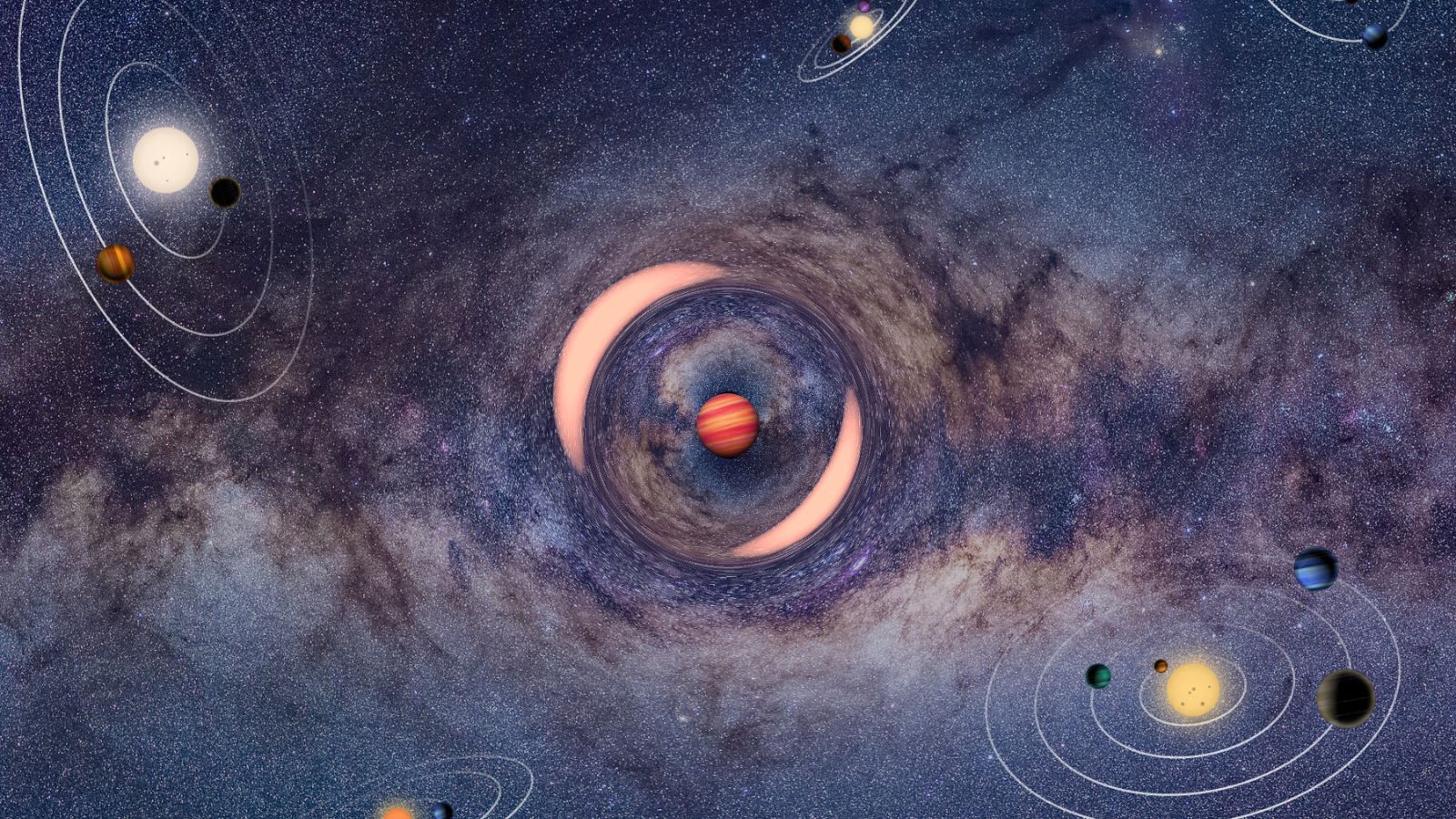
Astronomers have spotted a rare kind of world drifting through the Milky Way entirely on its own, confirming the existence of a “free-floating” planet nearly 10,000 light-years from Earth. The object, roughly comparable in size to Saturn, is one of the clearest examples yet of a planet that does not orbit any star.
Planets are usually detected because of the stars they circle, but this newly confirmed world belongs to a more elusive class known as rogue planets. Hints of such objects have surfaced before, yet they have been difficult to verify because they emit little to no light of their own. In this case, scientists were able to determine both the planet’s distance and its mass, a first for a rogue planet detected this way.
Located about 9,950 light-years away
The discovery was made after astronomers observed an unusual distortion in the light from a distant star in 2024. That brief brightening was recorded simultaneously by multiple ground-based telescopes and by the European Space Agency’s Gaia spacecraft, which has since been retired. By analysing the event from different vantage points, researchers concluded that the object responsible was a planet located about 9,950 light-years away, toward the crowded centre of the Milky Way, with a mass roughly 70 times that of the Earth.
Researchers say the finding strengthens the view that starless planets may be far more common than once thought. According to theoretical models of planetary system formation, violent gravitational interactions early in a system’s history can eject planets into interstellar space. In other cases, close encounters with passing stars may fling worlds away from their suns. Some scientists also believe that certain rogue planets may form in isolation, collapsing directly from clouds of gas and dust, much like stars do.
The role of gravitational microlensing
Detecting these wandering planets remains a major challenge. Because they produce almost no visible light, astronomers rely on a technique called gravitational microlensing. When a rogue planet passes in front of a distant star, its gravity briefly bends and magnifies the star’s light, creating a telltale signal. Until now, this method made it difficult to determine how far away such objects are, leaving open the possibility that some detections were actually failed stars known as brown dwarfs rather than true planets.
Also Read: Astronomers spot a rare planet orbiting twin stars with a 300-year-long year
In this case, observing the microlensing event from both Earth and space allowed scientists to calculate the planet’s distance with much greater accuracy. That, in turn, made it possible to estimate its mass based on how long the light distortion lasted.
Story continues below this ad
The researchers say the result adds to growing evidence that the Milky Way could be filled with lonely planets roaming between the stars. Future observatories are expected to dramatically expand the search. US-based space agency National Aeronautics and Space Administration’s (Nasa) Nancy Grace Roman Space Telescope, slated for launch as early as 2026, will survey vast regions of the galaxy at unprecedented speed, while China’s planned Earth 2.0 mission is also expected to hunt for free-floating worlds later in the decade.
The findings were published online on January 1 in the journal Science, offering a glimpse into a hidden population of planets that may rival stars themselves in number and reshaping scientists’ understanding of how planetary systems evolve and sometimes fall apart.
© IE Online Media Services Pvt Ltd