admin
admin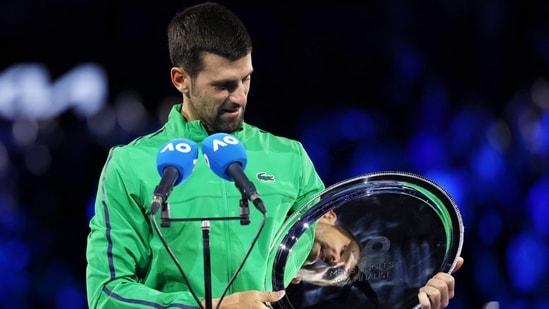
Rod Laver Arena has arguably never been as loud with the “Nole” chants as it was when Carlos Alcaraz misread Novak Djokovic’s return on a wide serve. For the first time since early in the second set, Djokovic had earned a break point in the final. But in the two hours that had elapsed since, the match and its momentum, had shifted dramatically.
A set earlier, Djokovic had been on the brink of clipping Alcaraz’s wings and soaring closer to his long-cherished dream of a historic 25th major. Now, at 40–30 up in the ninth game of the fourth set, the 38-year-old was jostling for survival.
He roped the crowd in, egging them on, searching for a last gasp of inspiration, perhaps even a way to burrow into Alcaraz’s mind as the roar swelled around the iconic venue. But this was not the same Alcaraz he had faced in the Melbourne quarterfinals a year earlier. Unfazed by the noise, the Spaniard reeled off the next three points to drive the final nail into Djokovic’s challenge.
Holding his arm aloft, Alcaraz turned to the stands, urging on the Spanish supporters inside Melbourne Park, with Rafael Nadal looking on from the stands.
At the ensuing changeover, Djokovic, pausing briefly as he sipped water, appeared momentarily absent, staring into the crowd as if the next game was the last thing on his mind.
He delayed the inevitable for two more games before being broken one final time, as Alcaraz became the youngest man in the Open Era to complete a Career Grand Slam. With it came yet another end to Djokovic’s pursuit of breaking free from Margaret Court’s all-time record.
The Australian Open of 2026 had perhaps been Djokovic’s clearest path to history, a chance that arrived unexpectedly, and one in which fortune appeared to favour him. A fourth-round walkover eased his passage, and in the quarterfinals he was staring at an early exit before Lorenzo Musetti, who had surged to a two-sets-to-love lead, was forced to retire injured early in the third. It all felt as though this tournament had aligned as Djokovic’s stairway to immortality.
In the vacuum left by Roger Federer’s retirement in 2022, a fading Rafael Nadal, and the prolonged wait for the Next Gen to assume control, Djokovic captured seven of the 12 Grand Slams between 2021 and 2023. Twice in that span he chased a calendar Grand Slam, lifting his tally to 24 majors, the most in the Open Era, male or female.
But with the arrival of a New World Order, led by Alcaraz and Jannik Sinner, Djokovic has reached just one major final in the two years since, falling to the Spaniard at Wimbledon in 2023.
Yet his run of four consecutive Grand Slam semifinals in 2025, a year after his Paris Olympics gold medal, underlined that even at 38, Djokovic remains firmly in the conversation. He is still a threat to the sport’s two young standard-bearers. That reality was reinforced when he outsmarted a two-time defending champion in Sinner in the Melbourne semifinals, cutting angles on the return and feeding off a partisan crowd to reassert himself as the title favourite, despite world No. 1 Alcaraz awaiting in the final.
Djokovic’s disruptive, high-wire tactics had unsettled Alcaraz at this venue a year earlier. But by 2026, the Spaniard had matured beyond those traps. The familiar smiles toward his box and the broadcast cameras were gone. Alcaraz was laser-focused, emotionally restrained, as he served Djokovic a dose of his own medicine on the sport’s biggest stage.
As Alcaraz and Sinner continue to redefine the sport, having now shared the last nine Grand Slam titles, the question inevitably arises: is Djokovic’s window for history closing? Perhaps not because of age alone, but because of the sheer magnitude of the task ahead. Any Slam run now likely demands beating one of them, if not both, deep in the tournament. Survive one, and the other almost certainly awaits.
And yet, Melbourne offered evidence that Djokovic is not finished. In three of his previous four Slam semifinal meetings with Alcaraz or Sinner in 2025, he failed to take a set. This time, he cracked Sinner’s defence and seized the opening set against Alcaraz, a small detail, perhaps, but not an insignificant one.
Because Alcaraz and Sinner know this much: until the day Novak Djokovic lays down his racquet, whether that is in six months, a year, or longer, he will remain right behind them, breathing down their necks.
Wimbledon, where he lifted seven of his career majors and reached the finals in 2023 and 2024, stands his best chance now, even though he will be 39 by then, followed by the US Open, where he won his last big title. But with or without the 25th, Djokovic will still go down in history as the most prolific tennis players across eras, male or female.