admin
admin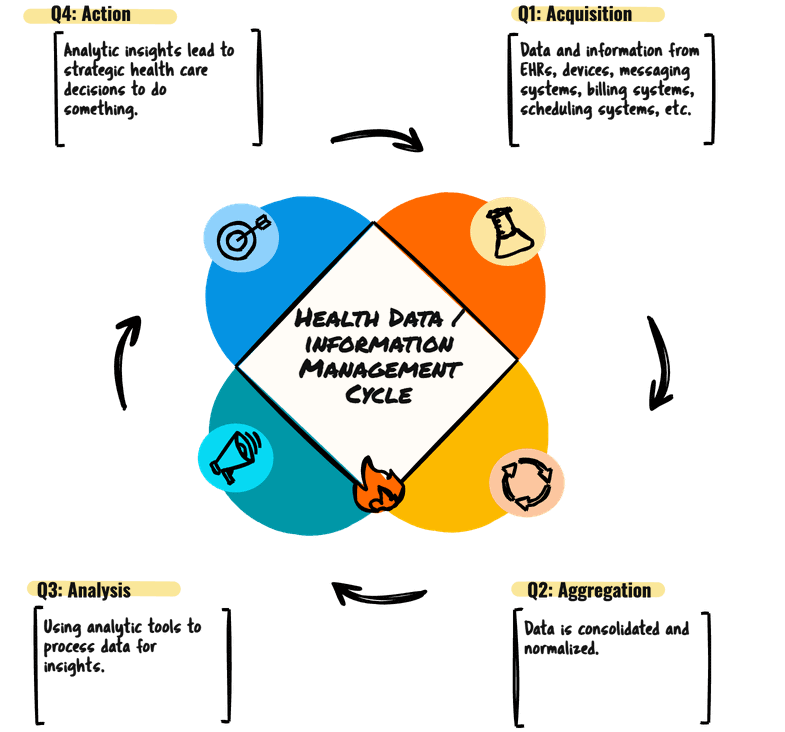
By JACOB REIDER
I haven’t blogged this yet, which kinda surprises me, since I find myself describing it often.
Let’s start with an overview. We can look at health information through the lens of a lifecycle.
The promise of Health Information Technology has been to help us – ideally to achieve optimal health in the people we serve.
The concept @ the beginning of the HITECH act was: “ADOPT, CONNECT, IMPROVE.”
These were the three pillars of the Meaningful Use Incentive programs.
Adopt technology so we can connect systems and therefore improve health.
Simple, yes?
Years later, one can argue that adoption and even connection have (mostly) been accomplished.
But the bridge between measurement and health improvement isn’t one we can easily cross with the current tools available to us.
Why?
Many of the technical solutions, particularly those that promote dashboardsare missing the most crucial piece of the puzzle. They get us close, but then they drop the ball.
And that’s where this “simple”AAAA” model becomes useful.
For data and information to be truly valuable in health care, it needs to complete a full cycle.
It’s not enough to just collect and display. There are four essential steps:
1. Acquire. This is where we gather the raw data & information. EHR entries, device readings, patient-reported outcomes … the gamut of information flowing into our systems. Note that I differentiate between data (transduced representations of the physical world: blood pressure, CBC, the DICOM representation of an MRI, medications actually taken) and information (diagnoses, ideas, symptoms, the problem list, medications prescribed) because data is reliably true and information is possibly true, and possibly inaccurate. We need to weigh these two kinds of inputs properly – as data is a much better input than information. (I’ll resist the temptation to go off on a vector about data being a preferable input for AI models too … perhaps that’s another post.)
2. Aggregate. Once acquired, this data and information needs to be brought together, normalized, and cleaned up. This is about making disparate data sources speak the same language, creating a unified repository so we can ask questions of one dataset rather than tens or hundreds.
3. Analyze. Now we can start to make sense of it. This is where clinical decision support (CDS) begins to take shape, how we can identify trends, flag anomalies, predict risks, and highlight opportunities for intervention. The analytics phase is where most current solutions end. A dashboard, an alert, a report … they all dump advice – like a bowl of spaghetti – into the lap of a human to sort it all out and figure out what to do.
Sure … you can see patterns, understand populations, and identify areas for improvement … All good things. The maturity of health information technology means that aggregation, normalization, and sophisticated analysis are now far more accessible and robust than ever before. We no longer need a dozen specialized point solutions to handle each step; modern platforms can integrate it all. This is good – but not good enough
A dashboard or analytics report, no matter how elegant, is ultimately passive. It shows you the truth, but it doesn’t do anything about it.
Act. This is where the rubber meets the road. It’s about translating insights into tangible interventions. What should happen (or not happen) next?
What good is knowing a patient is at high risk for readmission if that knowledge doesn’t trigger a specific follow-up protocol, a social work consultation, or an adjusted discharge plan? What’s the point of identifying a prescribing pattern if the system doesn’t facilitate a change in practice, provide immediate feedback to clinicians, or adjust order sets?
We have relied on human intervention to bridge this gap. A clinician might see a trend on a report and then manually initiate a change. We see a need for screening and make an order … (one-by-one-by-one).
So sad.
The true power of health IT, especially with the advancements we’ve seen, lies in closing this loop. We should be building systems that not only acquire, aggregate, and analyze data but also facilitate the next best actionprioritizing what’s best for the person we serve, and (of course) who should be the recipient of this guidance?
Imagine a system that not only flags a potential issue but also:
* Automatically generates a personalized patient education document.
* Suggests an updated medication order (or a set of orders) with one click.
* Schedules a follow-up appointments with the appropriate specialists .
* Pushes a notification to a care coordinator to intervene.
This isn’t about removing human judgment; it’s about empowering it. It’s about making the right thing to do the easiest thing to do.
The beauty of this cycle is its iterative nature.
The actions we take then generate new data and information, feeding back into the “Acquire” phase, allowing us to continuously refine our understanding and improve our interventions. And the faster and more frequently we can cycle through these four steps, the more responsive, efficient, and patient-centric our health care teams become.
Next time you’re evaluating a new Health IT solution, ask the crucial question: how does this system help us Act?
Jacob Reider MD is a family physician who previously served as Deputy National Coordinator at ASTP/ONC, CMIO at Allscripts and Albany Medical Center, CEO of Alliance for Better Health and currently doing angel investing, advising and pickleballing. Find his occasional thoughts at http://www.docnotes.net which is one of the few blogs older than THCB!