admin
admin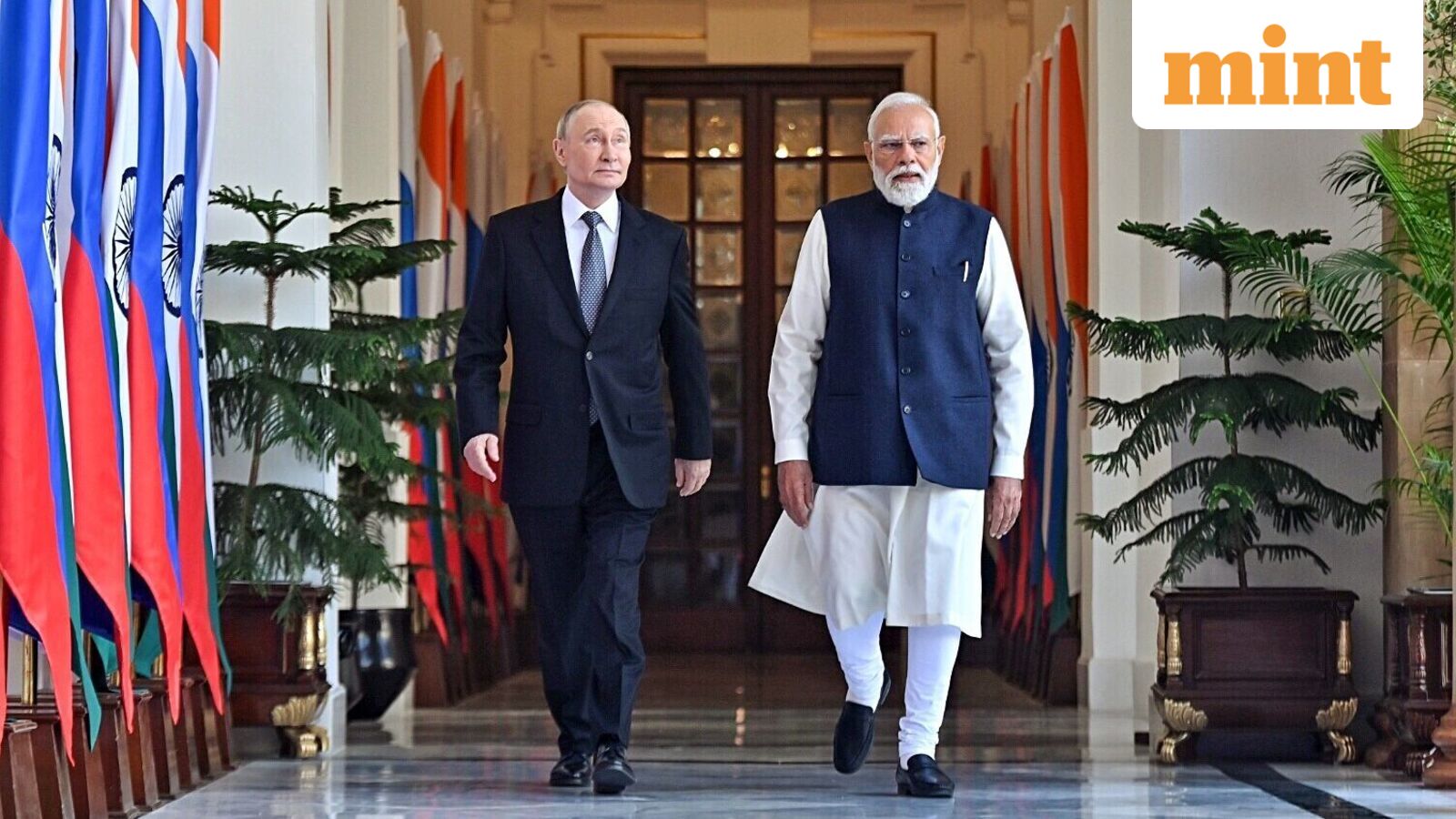
Putin India Visit: Indian stock markets are likely to have a positive impact by the Vladimir Putin’s India visit. The Russian President and PM Narendra Modi used their annual summit on Friday to announce a major expansion of bilateral cooperation, aiming to diversify trade well beyond oil and defence. The meeting came as the US renewed pressure on India to reassess its long-standing ties with Moscow amid efforts to advance a Ukraine peace deal.
“While the India–Russia partnership provides structural long-term positives for several sectors and supports a more diversified strategic footprint for India, the delayed India-US trade agreement is a moderating factor that markets will watch closely. The net effect, for now, is constructive for select themes like defence, infrastructure, energy, and critical minerals,” said Sugandha Sachdeva, Founder of SS WealthStreet.
The summit was especially significant, marking 25 years of the India–Russia Strategic Partnership established during Putin’s first visit to India in 2000. Both leaders confirmed that India and Russia have finalised a wide-ranging economic cooperation programme through 2030, focused on diversifying commerce and boosting annual trade. With India currently accounting for less than 2% of Russian imports, they set a new target of reaching $100 billion in bilateral trade by decade-end.
Market Impact: Key Opportunities Across Sectors
According to Ravi Singh, Chief Research Officer at Master Capital Services, the trade roadmap could meaningfully reshape India’s economic landscape.
“India and Russia are targeting a $100 billion trade relationship by 2030, an increase from $68 billion in FY25, fueled by India’s growing exports in key sectors,” he said. Singh believes sectors such as defence, pharmaceuticals, marine products, engineering, healthcare, IT-BPM, textiles, and jewellery stand to benefit from smoother approvals and wider market access. With Russia accounting for over one-third of India’s crude imports, consistent flows would cushion refiners against global price volatility. He noted that cheaper Urals crude and fertilisers reduce input costs across petrochemicals, agriculture, and manufacturing.
Defence, Energy Transition and Manufacturing
India and Russia’s new cooperation roadmap through 2030 is poised to reshape India’s industrial ecosystem, with analysts pointing to long-term gains across defence manufacturing, energy transition, nuclear power and critical-mineral security. Experts believe the framework strengthens India’s self-reliance agenda and provides insulation against global volatility.
Ross Maxwell, Global Strategy Lead at VT Markets, said the partnership enhances India’s medium-term growth outlook by ensuring predictable access to Russian resources, which helps India plan large-scale manufacturing and infrastructure projects more efficiently. “Stable energy supply supports India’s industrial and infrastructure prospects, while diversified supply chains also help protect growth from geopolitical shocks,” he said. Maxwell added that continued investment in defence production, nuclear capabilities and maritime logistics will strengthen India’s strategic resilience.
Ashwini Shami, President and Chief Portfolio Manager at OmniScience Capital, expects deeper technological collaboration to accelerate India’s energy-transition and indigenisation goals. He noted that joint production and co-innovation can boost domestic capabilities across defence systems, civil nuclear partnerships and critical-mineral supply chains.
Offering a balanced perspective, Harshal Dasani, Business Head at INVasset PMS, said predictable crude and raw-material flows will support energy and refining companies, with defence, logistics and engineering players also likely to benefit as bilateral projects scale up. However, he cautioned that geopolitical tensions, sanctions and supply-chain disruptions may still influence valuations. “We view this deal not as a tactical trade but as a structural variable shaping India’s strategic autonomy narrative,” he said.
Overall, analysts agree that while near-term market impact may be limited, the structural themes emerging from the India–Russia partnership could meaningfully shape sectoral opportunities over the next decade.
Stocks To Watch
Sachdeva of SS WealthStreet, said the new framework could help reduce India’s USD 68 billion trade deficit with Russia by boosting exports in pharmaceuticals, engineering goods, agriculture, and technology. She noted that stronger export flows and rupee-based settlements may “ease pressure on the Indian Rupee,” which recently hit ₹90.40 per dollar, and support external stability over time.
The sectoral impact is significant. Defence collaboration and Make in India initiatives could benefit HAL and Cochin Shipyardwhile transport-corridor development strengthens prospects for IRCON, L&T, and GMR. Long-term cooperation on strategic minerals and EV supply chains puts NALCO, Vedanta, and Hindalco in focus. Nuclear-energy expansion may also lift interest in L&T, BHEL, and MTAR Technologies.
However, Sachdeva cautioned that geopolitical tensions persist, warning that “any strain in India–US ties could keep the rupee under pressure” and add short-term risk for export-linked sectors.
Disclaimer: The views and recommendations made above are those of individual analysts or broking companies, and not of Mint. We advise investors to check with certified experts before making any investment decisions.