admin
admin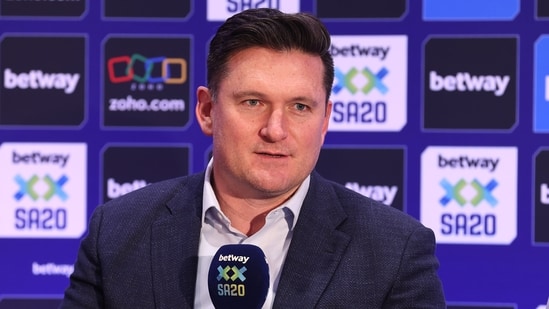
Two months ago, when SA20 marked ‘India Day’ at an event in Mumbai ahead of the league’s fourth season, former South Africa captain Graeme Smith had expressed hope for a strong start for the Temba Bavuma-led Proteas in the then-upcoming Test series in India, beginning in Kolkata. South Africa had beaten India in a Test series at home only once before, during the 1999–2000 tour, a time when Smith was yet to make his international debut.
This time, however, Smith watched from afar as the reigning World Test Championship holders replicated that historic 2–0 margin. South Africa not only stunned India in the Kolkata opener, where Bavuma’s gritty fifty stood out as the only half-century of the match, but also outplayed the hosts in Guwahati, a venue hosting its maiden Test.
On Friday, speaking to Indian media on the sidelines of a rain-hit SA20 fixture in Durban, Smith expressed another wish. He wants South Africa to avenge their loss to India in the 2024 T20 World Cup final. While the two sides are not in the same group for the upcoming ICC tournament in India, they could still cross paths in the Super Eight stage or the knockouts. For Smith, though, there would be no better stage for revenge than the final itself.
Smith laughed when reminded of his remark ahead of the Test series but said, “Obviously, I’d like us to beat India in the (T20 World Cup) final.”
The SA20 league commissioner, however, admitted he was taken aback by the sheer dominance South Africa displayed in India. Alongside Bavuma’s resilience, off-spinner Simon Harmer finished as the series’ leading wicket-taker with 17 scalps, while Marco Jansen claimed 12 wickets as South Africa handed Gautam Gambhir his second Test series whitewash since taking over as India head coach, the previous one coming against New Zealand exactly a year earlier.
“But yes, that was brilliant. We know it’s a tough place to tour. I was really surprised by how dominant we were in the Test series,” Smith said. “The Test side over the last year and a half has really been the beacon of light from a national team perspective. It’s been brilliant. Temba and Shukri Conrad have done wonders. Hopefully, it continues.”
Smith’s comments came despite South Africa having lost a five-match T20I series 1–3 against India on the same tour last month. Since then, Cricket South Africa’s selectors have made notable changes to the World Cup squad. While some of those calls raised eyebrows, Smith believes that if head coach Shukri Conrad can settle on the right combinations, South Africa have the potential to reach a second successive final, and possibly clinch their maiden ICC title in the format.
“I think in white-ball cricket there’s so much talent now,” Smith said. “If Shukri and the team get their combinations right, there’s a real opportunity to do well. There’s power, athleticism, and skill, and enough quality to play spin in the middle order, especially in Indian conditions. Hopefully, there’s a good World Cup around the corner.”
‘Would be surprised if India are not in top four’
When Gambhir was asked about the Test series defeat at home against South Africa in November, he said that one of the reasons for the defeat was that the team has been going through a transition phase with senior players like Virat Kohli, Rohit Sharma and Ravichandran Ashwin having exited the format all in a space of the previous 12 months.
While Smith acknowledged that India are navigating a transition of their own, he maintained that the depth of talent in the country makes them impossible to discount, especially on home soil, and admitted he would be surprised if they failed to reach at least the semifinals.
“With India’s talent, you can never write them off. It’s a home World Cup. And it does seem an interesting transition phase in Indian cricket between Gautam and senior players and who’s next and how that transition happens. And it seems to be in an interesting place. So, it’s going to be good to watch how things go. But certainly from a talent perspective, India, if they’re not in the last four at least, I’ll be very surprised,” he said.
Despite India’s concerns in the red-ball format, they have grown into a strong white-ball unit, having won the Champions Trophy in ODI cricket last year and the men’s T20 Asia Cup in September under Gambhir.
Smith in disagreement with South Africa selector
There has been a split in opinion within South African cricket over how the ongoing SA20 league should be viewed, with the debate largely centred around its relevance to the upcoming T20 World Cup. While World Cup-bound players such as Corbin Bosch and Keshav Maharaj see the league as an ideal platform for preparation, convenor selector Patrick Moroney believes there remains a significant gap between the SA20 and the standards of international cricket. Smith, however, sided with the players, describing the SA20 as an “excellent” preparatory platform.
“When you head into a World Cup, you always want to come off the back of highly competitive cricket. Speaking to players—local and international—they see SA20 as intense, high-quality cricket with full houses and world-class production. From a preparation perspective, that’s invaluable. What we can’t control are final combinations, who bats where, what balance the selectors want depending on conditions in India. But as a platform to prepare players mentally and competitively, SA20 is excellent,” he said.
The South Africa legend further said that SA20 has emerged as a crucial pathway for fringe and young players to push for national selection and gain global recognition.
“I think if you want to push for place in the South African team and you’re not in the kind of first 15 or 16 of names, this is the platform to do it. I think, you know, we’ve seen now, if you take IPL, I think last year we had 17-18 players from South Africa playing in the IPL. That’s the most international. And I think because of the platform of, you know, SA20. So, I think if you’re a young player like Mkwena or whatever that you’ve been talking about, no one knew about him until a few games ago. So, now there’s these opportunities for players to put their name in the global hat. When I was playing, you had to play for South Africa to be seen. You know, domestic cricket never got noticed around the world. Now you’ve got a product that everyone globally is looking at and saying, oh, there’s some real talent around. You know, so I think if you want to push for places, this is the tournament to do it.”