admin
admin
Yesterday’s Vijay Hazare Trophy (December 24) didn’t just feature big scores; it delivered a clear message about where 50-overs cricket in India is headed. When totals of 34-410 become routine across multiple venues, the economy stops being a comfort blanket and starts being a test of survival.
The most revealing subplot wasn’t simply the batters’ dominance. It was the sight of bowlers who normally carry a reputation for control, the ones captains expect to steady the innings, being beaten into brutal figures anyway.
When the economy bowlers bled
Day offered several run-fests that went beyond a single counter. For starters, Bihar scored a record 574/6 in 50 overs. Vidharbha made 382/5, and Bengal still chased it down, scoring 383/7. Jharkhand posted 412/8, and Karnataka replied with 413/5. Odisha hit 345/6, and Saurashtra replied with 347/5.
Against that scoring backdrop, here are five bowlers with a credible economical reputation who still leaked heavily on December 24.
Five control first bowlers who were taken apart
Bowler |
Why he’s considered economical |
Match (Dec 24) |
Figures |
| Akash Deep (Bengal) | List A career economy – 5.01 | Vidarbha vs Bengal | 9–0–86–0 (IS 9.60) |
| Harsh Dubey (Vidarbha) | List A career economy – 4.96 | Vidarbha vs Bengal | 10–0–95–0 (IS 9.50) |
| Shreyas Gopal (Karnataka) | List A career economy – 5.13 | Jharkhand vs Karnataka | 10–0–79–2 (ER 7.90) |
| Navdeep Saini (Delhi) | List A career economy – 5.36 | Andhra vs Delhi | 10–0–79–0 (ER 7.90) |
| Chetan Sakariya (Saurashtra) | List A career economy – 5.39 | Odisha vs Saurashtra | 8–0–66–0 (ER 8.25) |
These weren’t obscure names losing their radar. These are bowlers whose reputations, at different levels, are built around control, and still, the day pulled them into the same current.
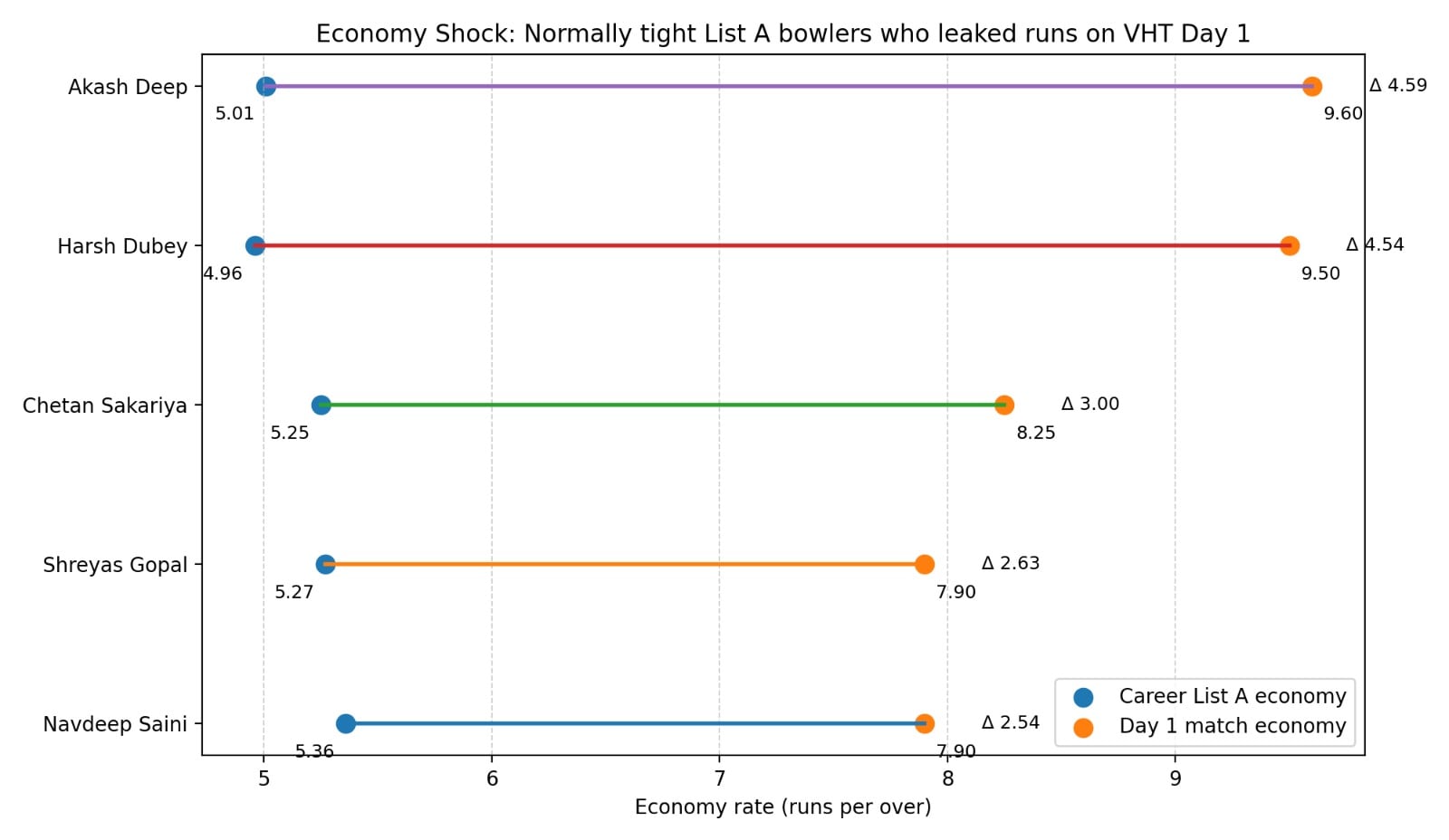
Akash Deep
He is typically the kind of seamer captains lean on for hard lengths and new ball control, and he’s also been part of IPL setups. Yesterday, Vidarbha turned Akash Deep’s ‘hit-the-deck’ zones into a runway on a wicket where discipline was basically a decorative concept.
Navdeep Saini
An Indian international with raw pace and history of being used as an impact bowler. Saini is rarely easy runs in domestic cricket. However, Andhra made him feel like a part-time option in a game Delhi still won, but not without Saini being dragged into the run-fest.
Chetan Sakariya
Left-armers who can often swing it and hit a length are supposed by the supervisers in high-scoring games. Odisha’s top order didn’t care; Chetan Sakariya went for an economy of over 8, while 345 runs were being put on the board.
Shreyas Gopal
A seasoned spinner with IPL pedigree, usually the guy who slows things down in the middle phase. Jharkhand blew straight past that idea in a 412 onslaught, where even a couple felt like minor relief.
Harsh Dubey
As Vidarbha captain, he is meant to the be the control lever, left-arm spin, and a tempo manager. However, Bengal treated him like a net bowler in a record chase and his failure to control things was a factor behind 382 not being defended.
Five non-experienced bowlers who faced the assault
Mibom Mosu
He was the bowler who was sitting at the extreme end of the VHT Day 1 violence. 116 runs in 10 overs, record runs conceded in List A cricket – a kind of spell that turns a match narrative into a meme.
Nabam Temple
As Bihar was tearing apart the Arunachal Pradesh bowling attack, Tempol accompained Mosu in sharing the assault. He conceded 72 runs in five overs. The Bihar batter targetted Mosu and Tempol the most on their way to 574 in 50 overs.
Tadakamalla Mohit
The number of Arunachal Pradesh bowlers in this list keeps extending. However, to Mohith’s credit, he at least got two wickets while conceding 99 runs in his nine overs.
Suryansh Singh
Another name from that Arunachal bowling attack. Suryavanshi, Sakibul Gani-led Bihar made a meal of the attack, and Suryansh Singh was also not spared. He bled 98 runs in nine overs.
Vikash Singh
While Karnataka was en route to their record chase, Vikash Singh faced the most wrath from the batter. He conceded 85 runs in just seven overs, helping Karnataka stay ahead of the ask in the chase.
Why everyone got hit and what this run-scoring tally signals
VHT Day 1 wasn’t the story of a few bad spells; it was a run environment story. When teams can post/chase totals like 574, 413, 383 easily, the common thread isn’t about an individual failure; it’s that the game is being played on surfaces and with tempos where par is basically extinct.
What it means going forward: except captains to front-load their best defensive options, protect their fifth bowler like a secret, and treat an economy of 7.5 to 8.5 as gold. And for batters, this is the clearest sign yet that the rhythm of the 50-over game has absorbed T20 instincts and the game is no longer a question of craft.