admin
admin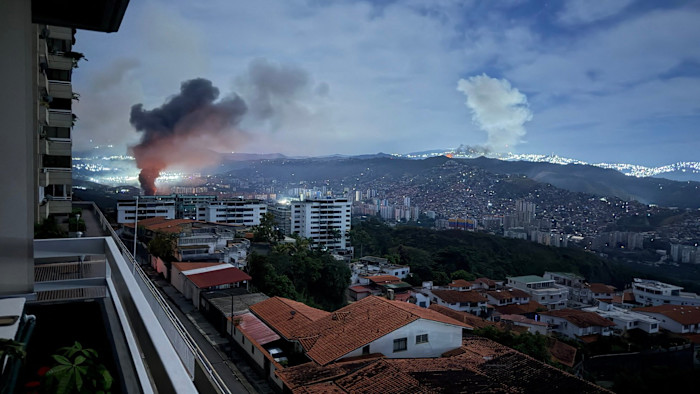
In the hours after US forces brought an end to the almost 13-year rule of Venezuela’s authoritarian leader Nicolás Maduro, an eerie silence reigned in Caracas, with shops shuttered and streets largely deserted.
Then, bit by bit, the headless regime sought to reaffirm its control.
Police and government-aligned paramilitaries known as collectives took to the streets. Near the Miraflores presidential palace in central Caracas, large screens were erected with messages in support of Maduro.
Protests supporting the abducted strongman emerged: near Miraflores, demonstrators chanted “give Maduro back” and wielded signs warning the government — whoever ends up leading it — not to make any deal with Washington.
“Not one drop of Venezuelan oil for the USA until we get Maduro back,” read one hastily scrawled placard. Men wearing civilian clothes and wielding assault rifles looked on.
For more than 12 hours there was a conspicuous absence: any public sight of vice-president Delcy Rodriguez, the country’s de facto leader after Donald Trump announced Maduro had been extracted by US special forces.
But if Rodríguez — who has a reputation as a pragmatist in a government dominated by hardline ideologues — has any intention of reconciling with Washington, she did not show it when she finally appeared in public on Saturday afternoon.
“There is only one president in this country, and his name is Nicolás Maduro,” said Rodríguez in a televised meeting, flanked by top officials including the interior, defence and foreign ministers, and her politician brother Jorge. “We will not be anyone’s colony; what is being done to Venezuela is barbaric.”
It was a stark rebuke to Trump’s assertion that Venezuela’s vice-president, who also serves as oil minister, would help run the oil-rich country.
“She is essentially willing to do what we think is necessary to make Venezuela great again,” Trump had said during a press conference earlier on Saturday.
He said the US itself would “run” Venezuela “until such time as we can do a safe, proper and judicious transition”, though the US had little visible presence on the ground after its rapid early-morning raid.

On Saturday night, the Supreme Court formally ordered Rodríguez to immediately assume and exercise presidential powers in an acting capacity.
Few people approached by the Financial Times in Caracas would openly criticise the government after nearly 16 months of intensified repression following the July 2024 election, in which Maduro was declared the victor by electoral authorities without providing a detailed breakdown of results.
“Of course we’re happy because Maduro has gone, but leaving Delcy in charge is ridiculous,” said Willy Oviedo, one local who was delivering medication to a family member.
“We hope that gets sorted and Edmundo takes her place,” Oviedo said, in reference to Edmundo González, who the US recognised as the winner of the 2024 election against Maduro after the opposition’s main leader María Corina Machado was banned from participating. An independently verified tally collected by the opposition showed that González won by a margin of two to one.

A government supporter, Miriam Bolívar, said: “Here we are, all Venezuelans of goodwill who love this homeland, standing in defence against the crime that has been committed against a free and sovereign country . . . They kidnapped our president!”
“We’re here demanding that our president is returned,” said Mariane Carreño, who lives in nearby social housing, a hallmark policy of Maduro’s late predecessor and mentor Hugo Chávez. “The US thinks they own the world.”
Arturo Sosa, a retiree shopping for bread at a local bakery on Saturday afternoon, said that the US now “has what it wanted” with Maduro out of the picture, and that “Delcy should take over and call elections”.
Most shops remained closed throughout the day; a few people ventured outside to jog or run errands, while others stayed glued to their screens for updates over what had happened and who was running their country.
The streets remained quiet on Sunday, with pro-Maduro activists calling for a march to take place during the morning.
Any celebrations by the Maduro regime’s many critics took place at home, with people probably deterred by the visible security presence on the streets.
Earlier on Saturday, Machado, who was awarded last year’s Nobel Peace Prize, praised the US operation that led to Maduro’s capture and said González “must immediately assume his constitutional mandate” as commander-in-chief of the country’s armed forces.

Machado has been outside Venezuela since she left to collect her peace prize in Oslo last month — breaking a travel ban to do so — while González, fearing arrest, went into exile in Spain in the aftermath of the 2024 election. Trump on Saturday dismissed the possibility that Machado could take charge.
As smoke still billowed from La Carlota airbase and the Fuerte Tiuna military base in Caracas, many opted to skip work for fear of reprisals from collectives
One motorcycle taxi driver said that in their working-class neighbourhood, the militia members were closely policing everyone on the streets and had forced the driver to return home. “They were guarding the entire neighbourhood,” the driver said.