admin
admin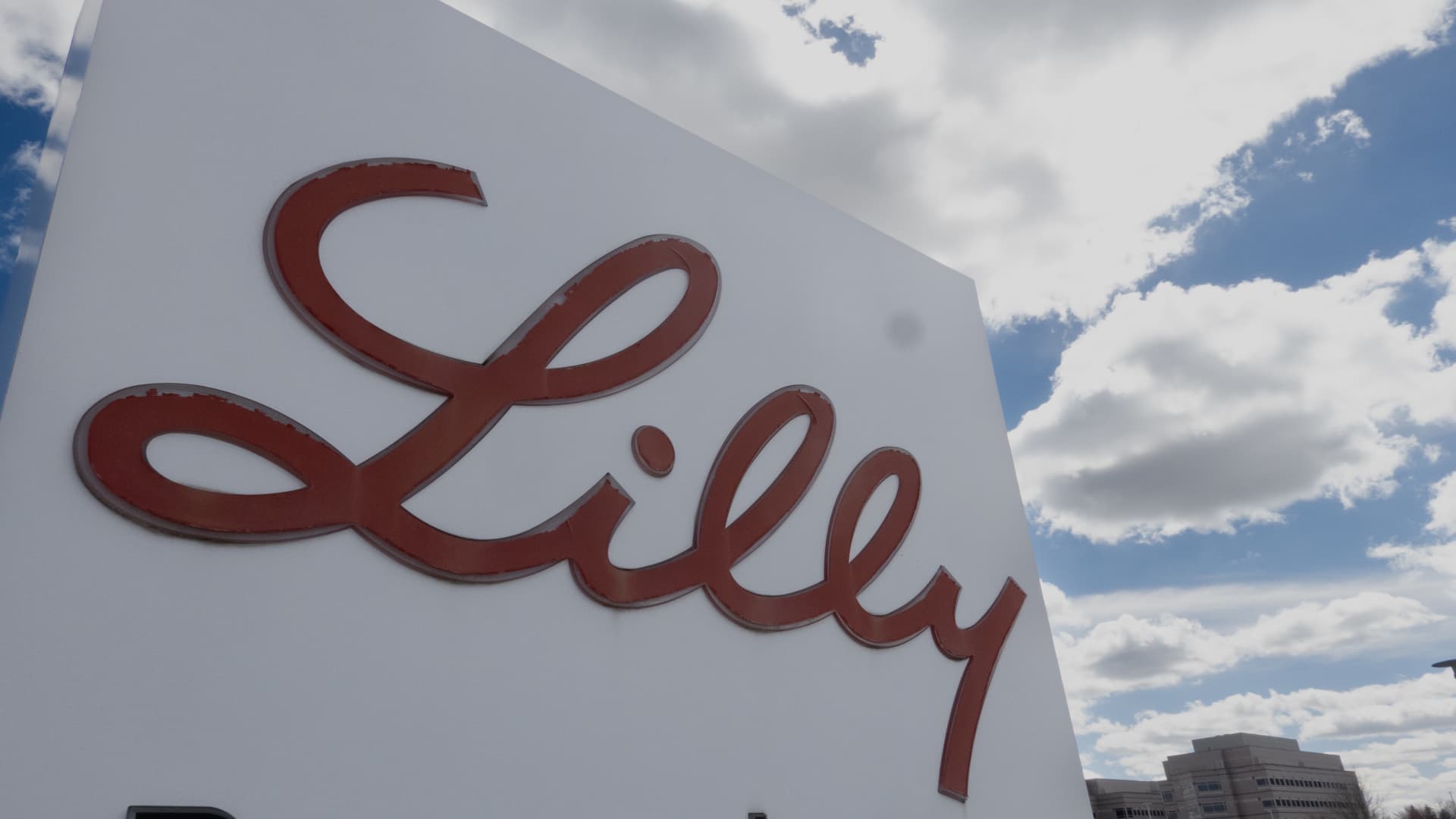
A sign with the company logo sits outside of the headquarters of Eli Lilly in Indianapolis, Indiana, on March 17, 2024.
Scott Olson | Getty Images
Eli Lilly reached a $1 trillion market capitalization on Friday, the first health-care company in the world to join the exclusive club dominated by tech firms.
Eli Lilly briefly hit the $1 trillion mark in morning trading before retreating. It was last trading around $1,048 a share. Eli Lilly is the second non-technology company to reach the coveted $1 trillion mark in the U.S. after Warren Buffett’s Berkshire Hathaway.
The drugmaker’s stock has climbed more than 36% this year as investors applaud the gains it has made over chief rival Novo Nordisk in the GLP-1 drug space. The Indianapolis, Indiana-based company’s stock has been riding the skyrocketing popularity of its weight loss injection Zepbound and diabetes treatment Mounjaro.
Eli Lilly’s stock has soared on the back of the success of its drugs Mounjaro and Zepbound.Demand is only expected to grow as approvals for the treatments’ uses and insurance coverage expand.
The two drugs have driven eye-popping sales growth for Eli Lilly. Last month, the drugmaker said Mounjaro drew in $6.52 billion in revenue in the third quarter, a 109% increase from the previous year. Meanwhile, Zepbound posted $3.59 billion in sales during the period, a 184% spike from the prior-year period.
Demand for the treatments will only grow as approvals for their use and insurance coverage expand. In addition, the drugmaker expects an oral version of its popular drugs to hit the market next year, which could give patients a more convenient option than a shot that is easier for the company to produce.
Eli Lilly will likely remain a dominant player in the weight loss drug market, which some analysts believe could be worth more than $150 billion by the early 2030s.
But despite its recent struggles and leadership shakeups, Novo Nordisk remains a formidable rival for Eli Lilly in the space. Pfizer also made a push forward in the market, as well, when it won a $10 billion bidding war with Novo Nordisk for obesity drugmaker Metsera earlier this month.
The runaway success of Zepbound, Mounjaro
Eli Lilly, a pharmaceutical chemist and Union veteran of the U.S. Civil War, founded his namesake company in 1876. It has long been at the forefront of the diabetes treatment space, introducing the world’s first commercial insulin in 1923.
Eli Lilly became a publicly traded company on the New York Stock Exchange by 1952, and for decades relied on a slate of widely successful products to drive much of its profits and revenue. That included insulins, the antidepressant pill Prozac and the earliest polio vaccine.
An Eli Lilly & Co. Zepbound injection pen, March 28, 2024.
Bloomberg | Bloomberg | Getty Images
Eli Lilly hit the jackpot with the May 2022 approval of tirzepatide for diabetes, which is sold as Mounjaro. It started to compete with Novo Nordisk’s diabetes injection Ozempic, which had entered the market a few years earlier.
But Eli Lilly brought a new way to treat diabetes and eventually, obesity. Tirzepatide works by imitating two hormones produced in the gut called GLP-1 and GIP. GLP-1 helps reduce food intake and appetite. GIP, which also suppresses appetite, may also improve how the body breaks down sugar and fat.
Meanwhile, Novo Nordisk’s semaglutide, the active ingredient in Ozempic and its weight loss drug Wegovy, only targets GLP-1.
Mounjaro achieved “blockbuster” status — meaning it generated more than $1 billion in annual sales — during its first full year on the market. Eli Lilly then won approval in late 2023 for tirzepatide as a treatment for obesity, which is sold as Zepbound and now competes with Novo Nordisk’s Wegovy.
By 2024, Mounjaro pulled in $11.54 billion in sales, while Zepbound posted $4.93 billion in revenue.