admin
admin
Uncharted Territory. By Chris Dalla Riva. Bloomsbury; 352 pages; $34 and £25
“Uncharted Territory” provides an entertaining and empirical look at how the Billboard chart has changed over the decades. Chris Dalla Riva—a data analyst, musician and occasional contributor to The Economist—has analysed hit songs to show how popular music has been shaped by society and technology.
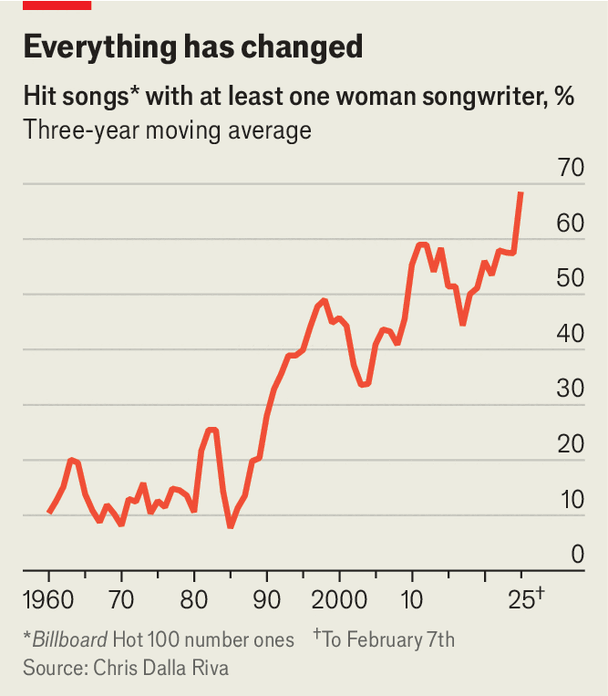
The idea for the book, which contains many illuminating charts, came from a Spotify playlist called “Every Number One Song on Billboard”. Founded in 1894, the American trade magazine published its first “popular song” chart based on sheet-music sales in 1913. Other rankings followed, based on record sales or tallies of song plays on jukeboxes and radio stations. In August 1958 Billboard consolidated them into one uber-chart, the Hot 100. Nearly 1,200 songs have occupied the coveted number-one spot since.
Mr Dalla Riva did not just listen: he noted down over 100 data points for each song, from the race and sex of the singers and songwriters to the instrumentation, key and time signature. It enabled him to tease out trends and organise modern popular music into about a dozen distinct eras. He could also answer important questions, such as: How many songs with a lead artist called Bob have topped the charts? (Twelve—but never one sung by Bob Dylan.) How significant are key changes? (In 1971 there were eight hits with a key change; so far this decade, there have been only four.)
The very first song to top Billboard’s consolidated chart, “Poor Little Fool”, revealed much about the industry. Sharon Sheeley, its 18-year-old writer, knew that a young female artist would not be taken seriously, so she lied and said that her godfather had penned the song when she was pitching it to Ricky Nelson. Female songwriters fare much better today.
These early years were also marked by death-narrative songs such as “Teen Angel” and “Leader of the Pack”—the war was still a raw memory—and genre crazes like surf rock or the twist. These invariably reached a saturation point, then faded away. In 1962, 22 twists debuted on the Hot 100; three years later there were none.
Throughout the 1960s the charts became less male and pale. Motown’s roster of girl groups, including the Supremes, frequently topped the charts; a third of number ones in 1963 featured black artists, up from a tenth five years earlier. The charts reflected other societal shifts, too. After the Stonewall riot in New York in 1969, gay people sought safe spaces where they could listen to music. Thanks to America’s 10,000 dance clubs—or “discos”—a scene was born.
The arrival of MTV in 1981 marked a new era, one in which a performer’s appearance and charisma mattered tremendously. The channel only had around 250 videos in rotation at launch—many of them made by British bands like Madness and Duran Duran—which contributed to a second British invasion. (The Beatles led the first charge.) The industry was also grappling with technological advances such as synthesisers and drum machines, which led human drummers to keep better time.
Data-collection technology was getting more accurate, too. In 1991, dubbed “The Most Important Year in Pop Music History”, the Hot 100 started using point-of-sales data from cash registers rather than the often-distorted numbers from record-store managers. The share of new songs in the top ten duly halved. Streaming data have changed the charts once again. Songwriters typically only get paid if people listen for at least 30 seconds, so long introductions went out of fashion and early choruses came in. Songs are also getting shorter to encourage more listens per hour (and more revenue).
YouTube replaced MTV as the place to watch music videos and the platform gave non-professionals a chance to have a hit. Billboard started incorporating YouTube views into its chart in 2013; immediately after the change was made, “Harlem Shake”, recorded in a bedroom and popularised online, topped the chart. Fast forward to today and TikTok is the latest music-discovery tool: 84% of songs that entered the Billboard Global 200 chart in 2024 had gone viral on the short-form video platform first.
Today the Hot 100 is a reflection of what is being streamed rather than what has recently been released. That is good news for the likes of Ms Lee. Her song is still moving with the times: in 2024 she released an AI-assisted Spanish-language version of her Christmas hit without even stepping into the recording studio. With AI-generated songs entering Billboard’s smaller charts in 2025, it seems inevitable they will crack the Hot 100. Perhaps those tunes will also have “Everyone dancin’ merrily/In the new old-fashioned way.”
For more on the latest books, films, TV shows, albums and controversies, sign up to Plot Twistour weekly subscriber-only newsletter