admin
admin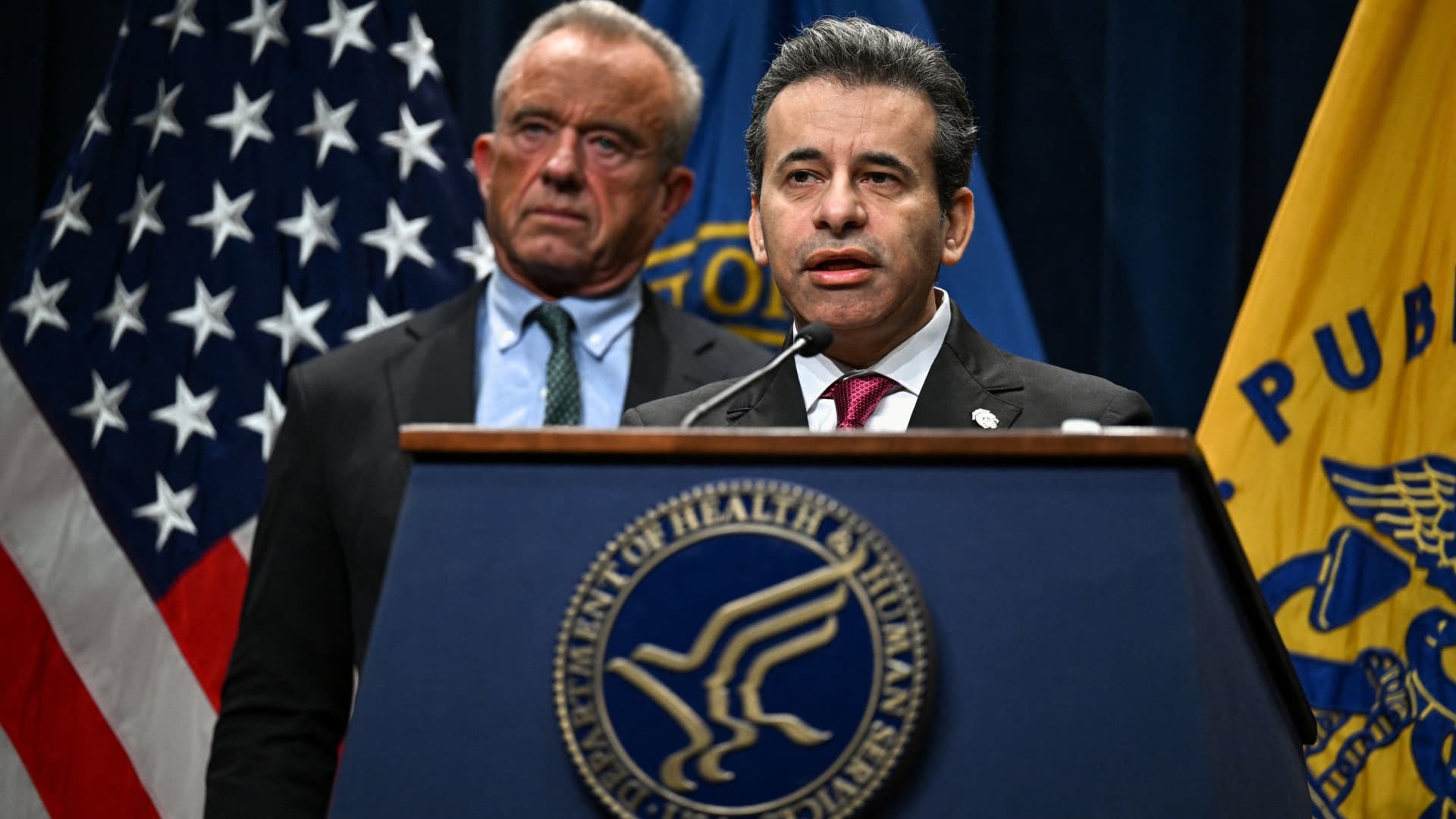
U.S. Food and Drug Administration Commissioner Marty Makary speaks during a press conference alongside U.S. Secretary of Health and Human Services Robert F. Kennedy Jr., and Centers for Medicare & Medicaid Services Administrator Mehmet Oz, discussing administration plans to lower drug costs, at the Department of Health and Human Services in Washington, D.C., U.S., Oct. 29, 2025.
Annabelle Gordon | Reuters
The Food and Drug Administration on Wednesday said it will take steps to speed up the process of developing generic versions of complex biological drugs, in a bid to increase cheaper competition for expensive medicines and lower drug costs for Americans.
It’s the Trump administration’s latest move to rein in high prescription drug costs in the U.S., where medication prices are two-to-three times higher than those in other developed nations.
The move to support the development and approval of so-called biosimilars could be a blow to pharmaceutical companies, whose most profitable products are often biological products that treat serious and chronic diseases. The exact impact will depend on the drugmaker and its products.
In a statement on Wednesday, a Health and Human Services Department spokesperson said the law gives manufacturers 12 years of exclusivity for biologic medicines, which is a “primary determining factor in drug development decision-making.”
“No manufacturer should anticipate a monopoly or anything else beyond what is legally granted,” the spokesperson said.
The FDA’s new reforms “will take the five-to-eight year timeframe to bring a biosimilar to market and cut it in half,” the agency’s Commissioner Marty Makary said during a press conference on Wednesday.
During the event, HHS Secretary Robert F. Kennedy Jr. said the FDA has an “outdated and burdensome approval process that has slowed down the entry of biosimilars.” He said “even when (the drugs) do get approved, current laws often prevent pharmacists or patients from substituting them for patients who would benefit from a more affordable option.”
“That all ends today, a the FDA is taking bold, decisive action to break down these barriers and open the markets for real competition,” Kennedy said.
Biological products are engineered with living cells, which makes manufacturing more complex than for chemically derived drugs. Biologics have a special pathway to FDA approval, and it is harder for generic drug manufacturers to sell cheaper versions due to the high costs of development and difficult regulatory landscape.
Biologic medications make up only 5% of prescriptions in the U.S., but account for 51% of total drug spending as of 2024, according to an FDA release. FDA-approved biosimilars are as safe and effective as their branded counterparts, yet their market share remains below 20%, the agency added. The FDA said it has so far approved 76 biosimilars, making up only a small fraction of approved biologic drugs.
Kennedy said biosimilars, on average, cost half the price of their branded counterparts. Their entry into the market drives down brand-name drug prices by another 25%, which is a “real relief for patients,” he added.
Biosimilar generics saved $20 billion in U.S. health-care costs last year alone, the FDA said.
In a new draft guidancethe FDA proposed major updates to simplify biosimilar studies. For example, the agency recommended that human studies directly comparing the biosimilar to a branded product may not be necessary for drug companies to conduct. That research takes years and costs tens of millions of dollars.
Biosimilars have historically struggled to gain market share from their branded counterparts compared to generic copies of small-molecule drugs, which are often delivered in pill form and can enter cells easily because it has a low molecular weight.
The difference is that many biosimilars aren’t identical copies of branded biologic drugs, while generics are.
In many cases, pharmacists can’t directly substitute a branded biologic for a biosimilar when filling a prescription unless they are classified as “interchangeable” and it is permitted by state law.
But the FDA on Wednesday said it generally recommends against requiring so-called “switching studies,” which determine whether biosimilars have that classification. That step is not required for generic copies of small-molecule drugs.
“These additional studies can slow development and create public confusion about biosimilar safety,” the FDA said in a release.