admin
admin
MUMBAI: Domestic equities were shaken by the ‘Trump factor’ throughout the week, leaving India the worst-performing major market globally as risk-off sentiment gripped investors.
Markets struggled amid a trio of US-driven shocks. Sentiment was hit by Friday’s announcement that US Commerce Secretary Howard Lutnick signalled a delay in the India-US trade agreement. Concerns deepened as the proposed Sanctioning Russia Act of 2025, which threatens tariffs of up to 500% on countries still buying Russian oil, advanced in Congress, stoking concerns over India’s growth and market stability.
The resulting sell-off was brutal. In its sharpest weekly decline since 26 September 2025, the Nifty 50 shed 2.5% to settle at 25,683.30 on Friday, slipping below the psychologically significant 26,000 mark. Losses extended across all five trading sessions.
Sentiment had also been rattled earlier in the week by the US military’s capture of Venezuelan President Nicolás Maduro, triggering a broad-based sectoral retreat.
While the broader market retreated, consumer durables emerged as the sole outlier rising 2.4% during the week, driven by festive demand spillover and upbeat Q3 expectations for Havells and Polycab, said Akhil Bharadwaj, senior partner at Alpha Capital.
In contrast, oil and gas plunged 5.4%, followed by power and capital goods, which fell 4.4% and 2.5%, respectively. Tariff anxiety hit the oil and gas sector hardest, led by Reliance Industries’ 7.4% drop that erased nearly $15 billion in market capitalization, Bharadwaj noted.
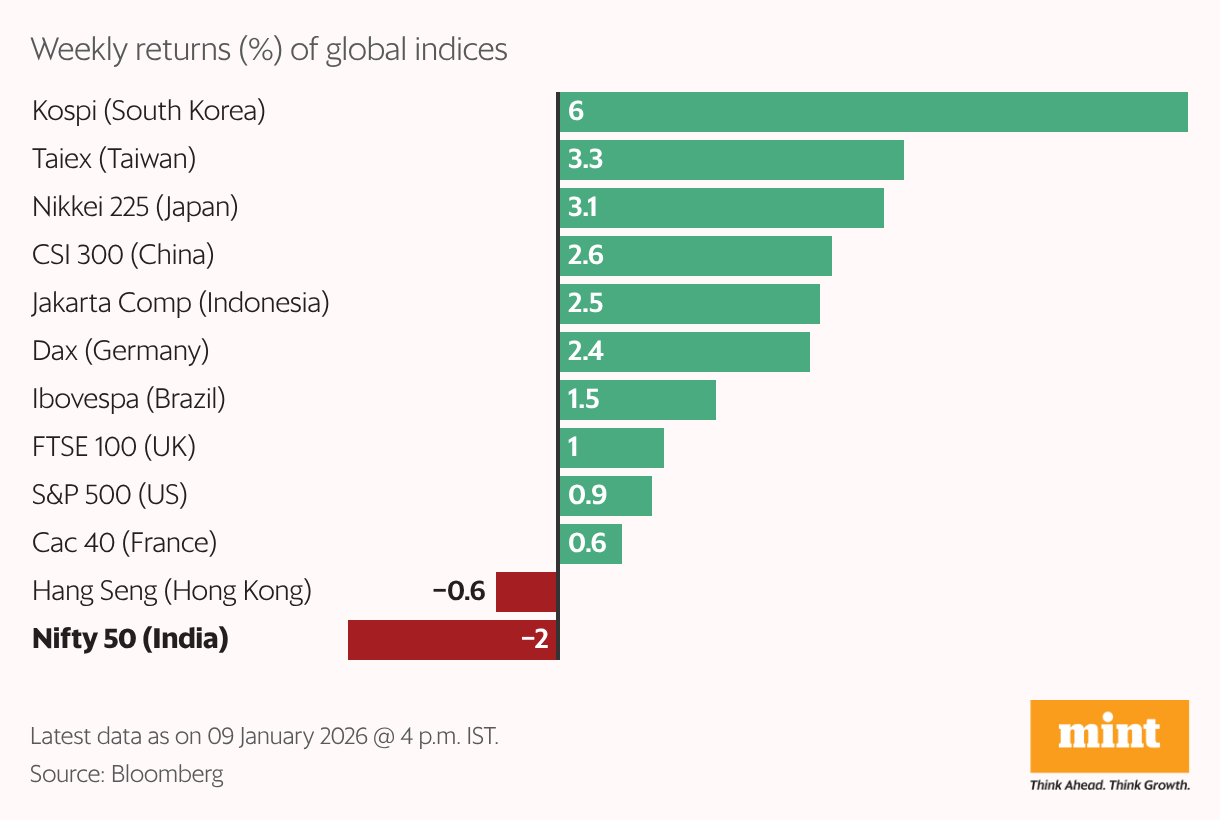
Globally, India saw the steepest declines across major developed and emerging markets, even as peers like South Korea, Taiwan, and Indonesia ended the week higher. Bharadwaj noted that tariff threats from the US are intersecting with domestic weaknesses like foreign outflows and currency depreciation, widening the divergence.
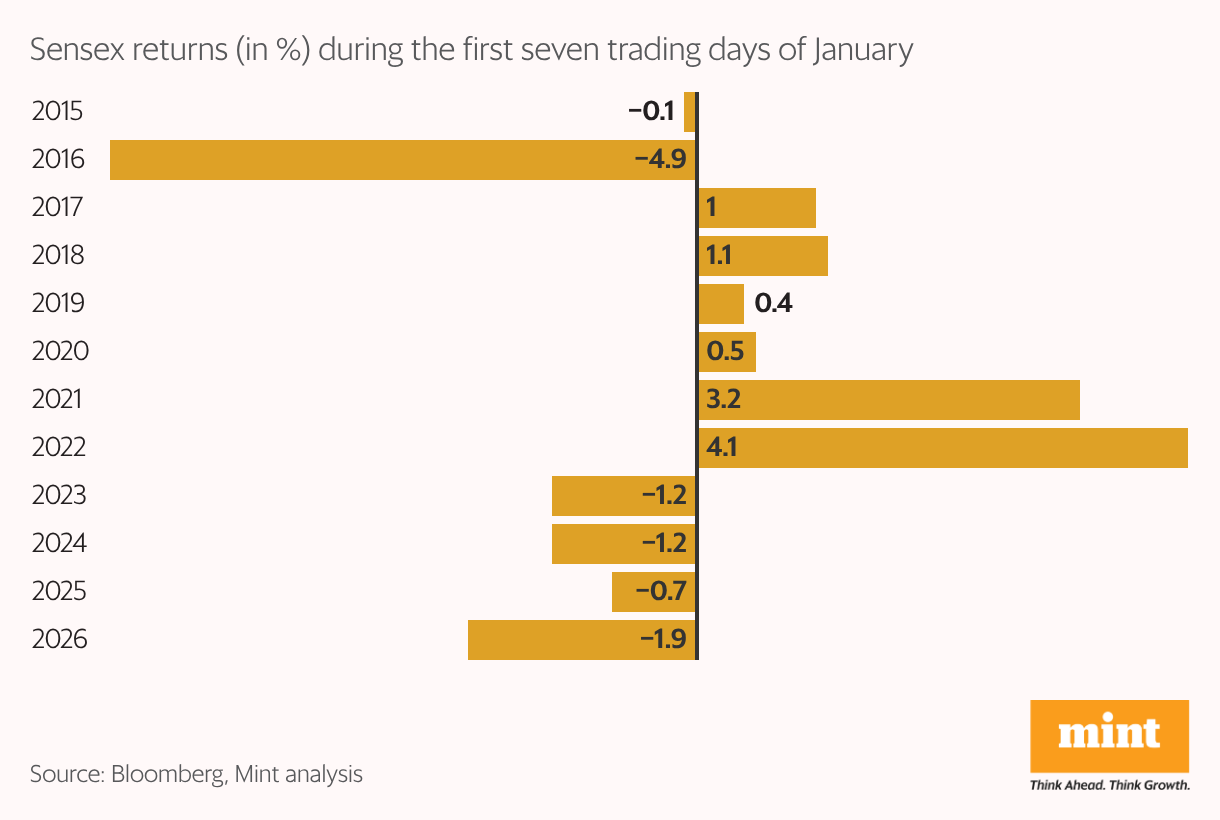
Against this backdrop, the 30-scrip blue chip index Sensex logged its worst start to a new year in a decade, falling nearly 2% in the first seven trading sessions, Mint’s analysis showed. This stands in stark contrast to the previous year when the index saw a marginal decline of 0.7% during this period.
“Holiday-thinned liquidity and lingering valuation concerns accelerated profit-booking and deepened the sell-off,” said Bharadwaj.
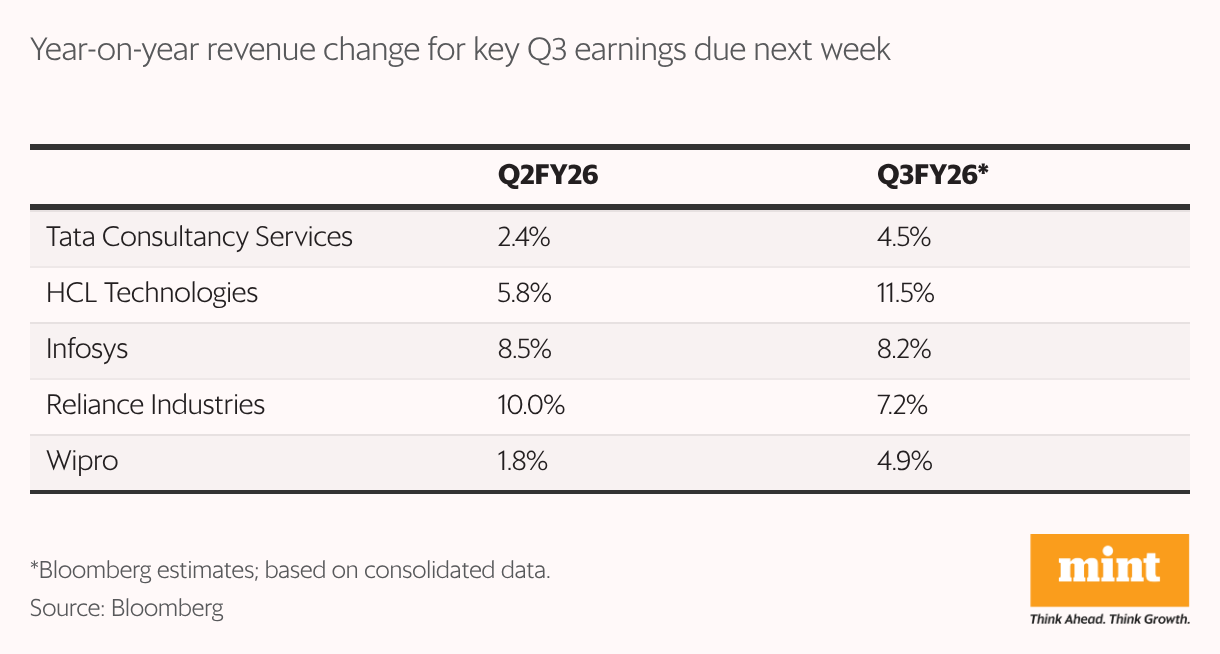
Looking ahead, markets will focus on the December-quarter earnings season, which kicks off next week with IT heavyweights Tata Consultancy Services and HCL Technologies reporting numbers on Monday. Nearly 40 Nifty 500 companies will announce Q3FY26 results, with Infosys, Wipro, and Reliance Industries expected to set the broader market tone.
A critical area of focus will be how the IT sector navigates seasonal furloughs and margin pressures following a subdued second quarter. “For TCS and HCLTech, the Street expects 1-3% sequential constant-currency growth as BFSI and hi-tech deals ramp up, but margins may contract 30-40 bps on furloughs,” said Bharadwaj. Early beats from these bellwethers could reinforce the earnings recovery narrative and bolster sentiment, he added.
Investors will also track December retail inflation data, due on Monday, and a key US Supreme Court ruling on American tariffs for direction.